The literature on one reaction

"72 publications on ciprofloxacin and tendon rupture were found; the first appeared in Oct 1992, and 25 are case reports." The line under it: "PubMed searched on 2026-10-27: 73 hits for this query, all held." Chips split the publications by type: 31 studies, 25 case reports, 12 meta-analyses, 4 observational studies. "1 of 72 studies have an author affiliated with a company of the drug."
PubMed dates the first of these, Lee et al.'s case report, October 1992, with no day, and the card shows it at month precision. Below the counts, the card lists each study with its date, journal and type, and the finding quoted from the paper. A Studies per year chart stacks each year's publications by type (case report, observational study, trial, review, other). From a 2020 study in BMJ Open, the quote is about one outcome and one window: in the 30-day window, levofloxacin showed an increased risk of rotator-cuff rupture (HR 1.16; 95% CI 1.06 to 1.28) and of Achilles tendon rupture (HR 2.20; 95% CI 1.50 to 3.24), while ciprofloxacin and moxifloxacin showed no increase in combined tendon ruptures.[3]
Trial results, arm by arm
The trial results card lists the trials of a drug that posted results on ClinicalTrials.gov. For each arm it gives how many participants had the reaction ("affected") and how many could have had it ("at risk"), with serious and non-serious events listed apart. Every trial shows its posting date, sponsor and reporting time frame. The numbers are not pooled across trials.
What regulators abroad did
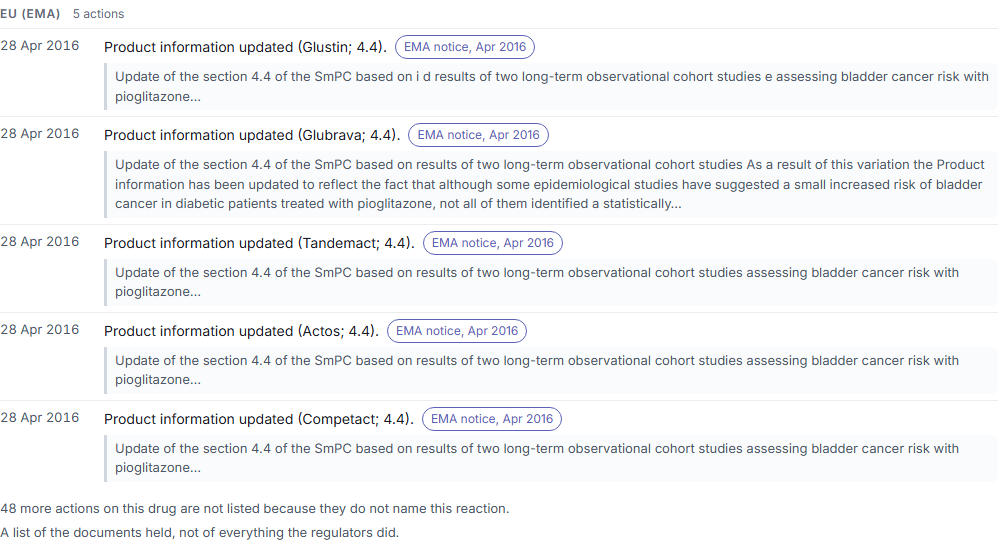
For pioglitazone and bladder cancer, the card lists each regulator's actions with their dates:
- UK (MHRA), 1 action: August 2011 (the MHRA article gives the month, not a day), "Communication to prescribers", quoting "The potential risk of bladder cancer with pioglitazone was first identified at the time of licensing, observed in male rats in an animal toxicity study that supported the initial licence application."
- EU (EMA), 5 actions: 28 Apr 2016, "Product information updated" for Glustin, Glubrava, Tandemact, Actos and Competact, each in section 4.4 of the SmPC.
"48 more actions on this drug are not listed because they do not name this reaction." Canada Vigilance reports are kept out of the US counts.
Example questions
For every side effect of Ozempic, which appeared in published studies before the label warned, and how long before?
What comes back: For each side effect, the first publication, the first label mention, the first warning, and the months between.
Did EMA, MHRA or Health Canada warn before FDA, and by how long?
What comes back: Each regulator's action with its date and the quoted text, and the gap to the US label.
Sources
- National Library of Medicine, "About PubMed," https://pubmed.ncbi.nlm.nih.gov/about/
- ClinicalTrials.gov, "About ClinicalTrials.gov," https://clinicaltrials.gov/about-site/about-ctg
- Baik S et al., BMJ Open 2020, PMID 33371012, https://pubmed.ncbi.nlm.nih.gov/33371012/