Pharma and device safety, regulatory and legal teams
Pharmacovigilance, regulatory affairs and in-house counsel read the same public record about their products that a plaintiff firm, an analyst or a reporter reads. The question is what that record shows, in what order, and what a reader could have concluded on a given date. Every item comes with its kind of date: the study's publication, the company's submission, FDA's approval.
Five questions about your own products
"For every side effect of Ozempic, which appeared in published studies before the label warned, and how long before?"
What comes back: each side effect, its first study, the first label to name it, and the gap.
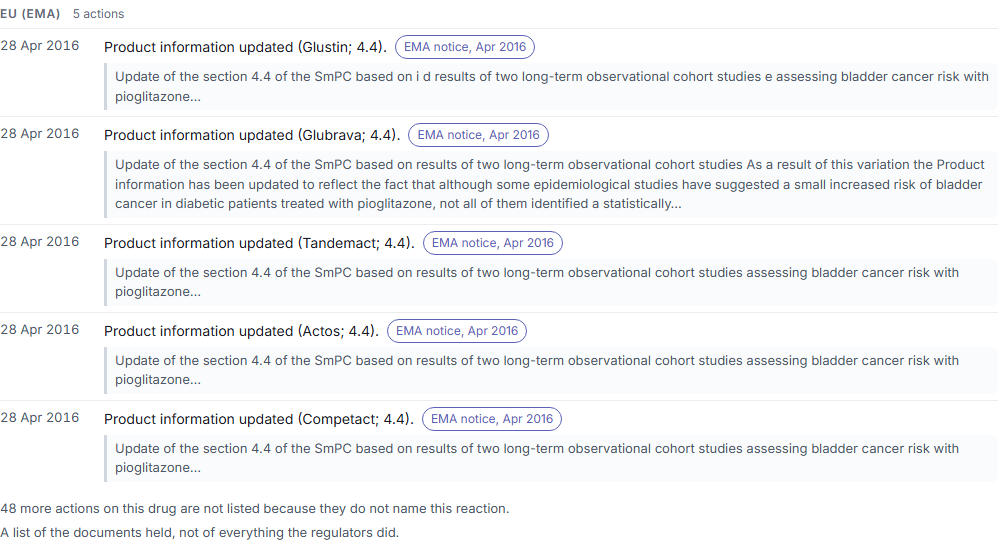
"Did regulators abroad act on pioglitazone and bladder cancer before the US label changed?"
What comes back: the foreign regulator card, by agency. EU (EMA), 5 actions: product information updated on 28 Apr 2016 for Actos, Competact, Glubrava, Glustin and Tandemact, section 4.4 of the SmPC, "based on results of two long-term observational cohort studies". UK (MHRA), 1 action: a communication to prescribers in August 2011. Each is quoted and linked to the EMA or MHRA document. The card says what it leaves out: "48 more actions on this drug are not listed because they do not name this reaction." The answer names the regulators searched: "EMA, MHRA, Health Canada and Swissmedic, but not Japan's PMDA."
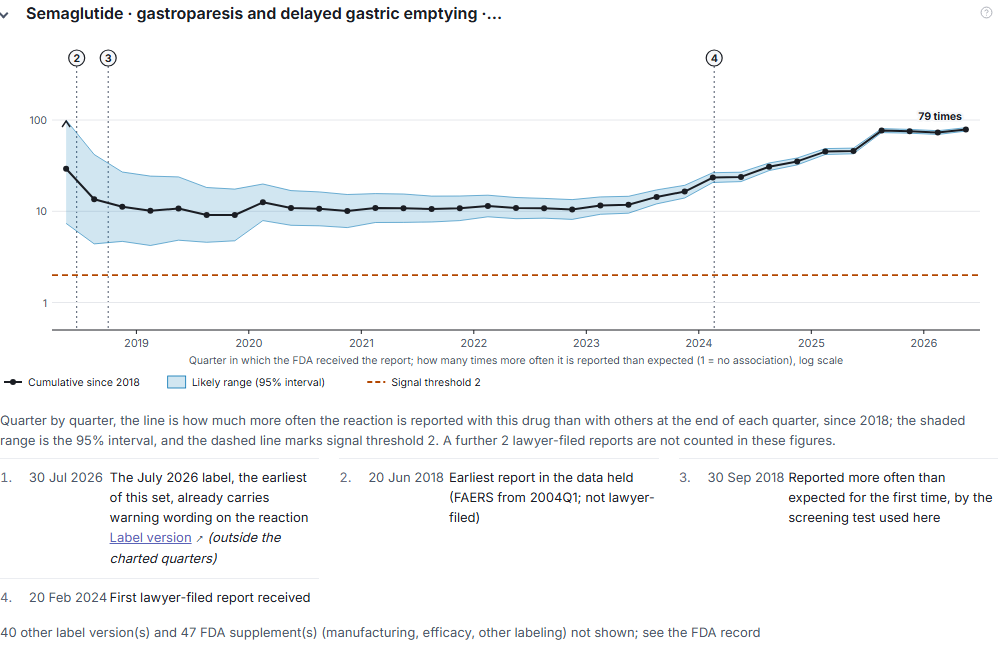
"Is there a disproportionality signal for gastroparesis with semaglutide? Show how it developed over time."
What comes back: the cumulative PRR for every quarter since 2018Q2 with its report count, the rule ("PRR ≥ 2, chi-squared ≥ 4, and at least 3 reports") and the date it was first met. The chart marks the label version and the first lawyer-filed report on the same time axis, and notes "40 other label version(s) and 47 FDA supplement(s) (manufacturing, efficacy, other labeling) not shown". Reports and claims for Medicare Part D, and for Medicaid, follow as two separate tables.
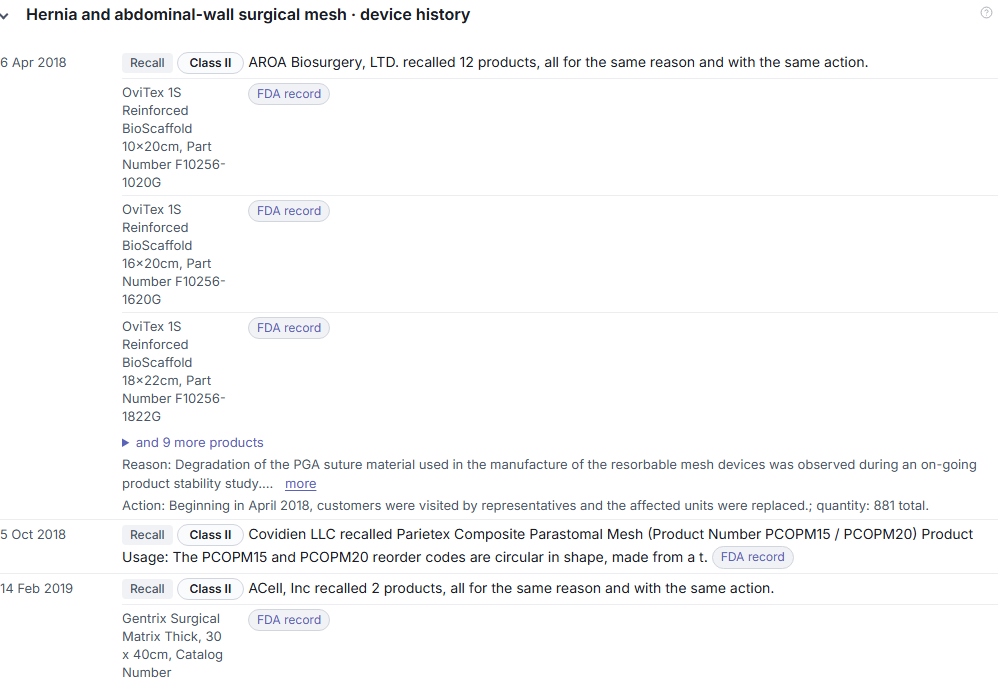
"Surgical mesh migration: what device recalls and adverse event signals exist?"
What comes back: "FDA's recall search returned 150 recall product records for surgical polymeric mesh and seven related mesh categories", with each category's FDA product code. The device history card lists up to 60 recall events by date, each with its class, the firm's stated reason and the FDA record. "Class I is the most serious recall class, Class III the least."
"Which GLP-1 drugs gained new evidence of pancreatitis in the last 90 days, and did any foreign regulator act first?"
What comes back: an Emerging Evidence watch list, with foreign warnings and their dates. On the Watch lists page, enter a Drug or a Condition, a "Side effect (optional)" and a "Look back" window, then press Start watching. Each check compares the result with the previous one and adds one alert listing the evidence added or removed (a new reporting signal, a new study, a regulator acting abroad, a label change), each linked to its source. The first check sets the baseline.
The labeling rule these dates feed
FDA's regulation lets a manufacturer change a label to reflect newly acquired information, including to add or strengthen a warning where the evidence of a causal association meets the standard for inclusion in the labeling.[1] Newly acquired information means data, analyses or other information not previously submitted to the agency.[2] Under Merck Sharp & Dohme Corp. v. Albrecht, a manufacturer claiming preemption must show it fully informed FDA of the reasons for the warning and that FDA told it the agency would not approve the change.[3] The submissions, FDA's responses and the label versions sit on one time axis, so counsel can read the sequence before an opponent does.
What you can check
- The passage behind each statement, opened beside the answer with the supporting text highlighted.
- The kind of each date: published, submitted or approved.
- The data line under each answer, with the FAERS quarter, the snapshot and whether lawyer-filed reports were shown apart or excluded.
- "How this is measured" and "Search scope and limits" under each card.
- The Expert pack: exhibits, a methods appendix and a command that reruns the eligible snapshot-backed calculations and lists the exhibits it cannot verify. Export as PDF or Word.
Sources
- 21 CFR 314.70(c)(6)(iii)(A). https://www.law.cornell.edu/cfr/text/21/314.70
- 21 CFR 314.3(b), "Newly acquired information." https://www.law.cornell.edu/cfr/text/21/314.3
- Merck Sharp & Dohme Corp. v. Albrecht, 587 U.S. 299 (2019), decided May 20, 2019. https://www.law.cornell.edu/supremecourt/text/17-290