Plaintiff firms
Screening a drug or device injury turns on dates. You need the client's start date, the label in force that day, what FDA and the manufacturer had by then, and who held the application. Name the drug, the injury and the start date. Each statement in the answer cites the label version, FDA document or study it rests on.
Five screening questions
"What was published and filed about pigmentary maculopathy with Elmiron before the label warned of it, and when did the company propose the warning?"
What comes back: the dated record, each date typed. Pearce et al. published online on 22 May 2018.[1] The company submitted supplement S-014 on 24 June 2019, proposing a warning of retinal pigmentary changes. FDA approved it on 16 June 2020. The answer cites 21 CFR 314.70(c)(6)(iii) and 21 CFR 314.3 for the route by which a company may add a warning on newly acquired information. Kelsey sets out these dates and sources; it does not decide the date on which a defendant had legal notice.
"Show the label history of Elmiron for pigmentary maculopathy: when did the label first name it, and in which section?"
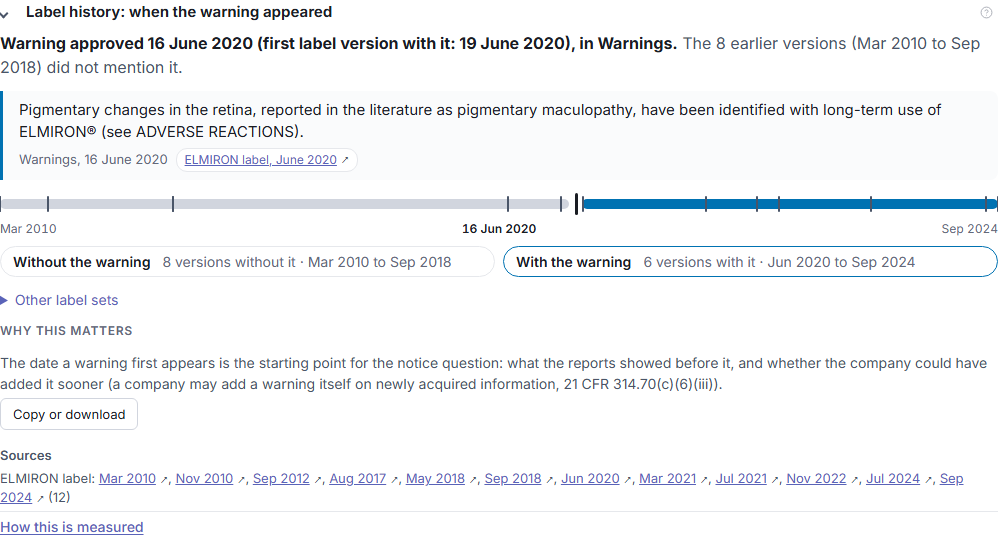
What comes back: "Warning approved 16 June 2020 (first label version with it: 19 June 2020), in Warnings. The 8 earlier versions (Mar 2010 to Sep 2018) did not mention it." Below that, the warning sentence as printed on the label,[2] a time bar split into "Without the warning" (8 versions) and "With the warning" (6 versions), and the label versions linked to DailyMed under Sources.
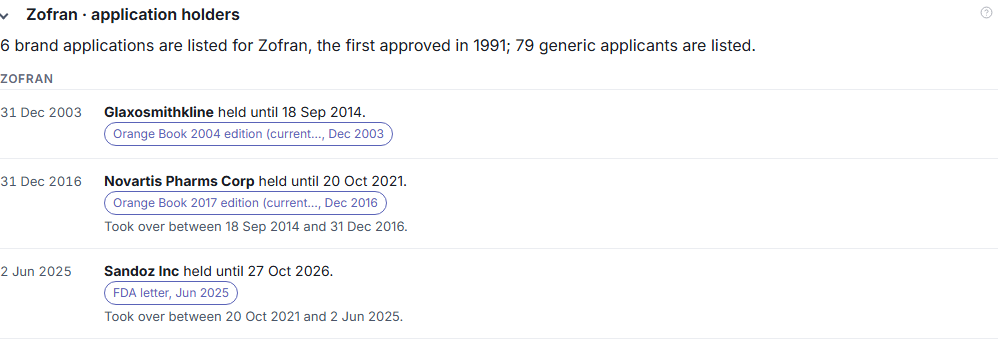
"Who has held the NDA for Zofran (ondansetron), and what FDA actions were taken on it?"
What comes back: "6 brand applications are listed for Zofran, the first approved in 1991; 79 generic applicants are listed." Each holder is dated from an FDA letter or an Orange Book edition, and the dates are those of the records, not of the transfers: GlaxoSmithKline is first observed as holder on 31 Dec 2003 and last observed on 18 Sep 2014; Novartis is first observed on 31 Dec 2016 ("Took over between 18 Sep 2014 and 31 Dec 2016"); Sandoz is first observed on 2 Jun 2025. The generic applicants follow, each with its approval date.
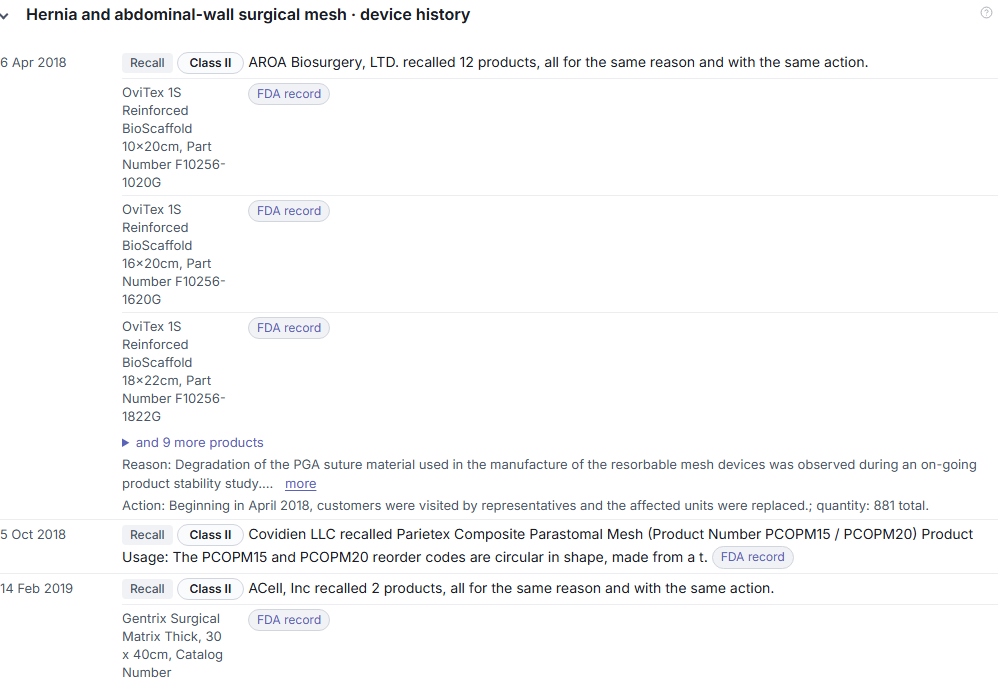
"Surgical mesh migration: what device recalls and adverse event signals exist?"
What comes back: "FDA's recall search returned 150 recall product records for surgical polymeric mesh and seven related mesh categories". A migration signal needs one FDA product code, so the answer lists the codes and asks which one to check. The device history card lists each recall by date and class, with the firm's stated reason and a link to the FDA record.
"Which drugs are most often reported with this injury, and did their labels warn before my client started in March 2019?"
What comes back: the candidate drugs, the label in force on 1 March 2019 for each, and when each warning appeared.
The rules these dates answer to
In Wyeth v. Levine, the Supreme Court held that federal law did not preempt a failure-to-warn claim over Phenergan's label, relying on the "changes being effected" process that lets a manufacturer add or strengthen a warning without waiting for FDA approval.[3] That route covers newly acquired information, defined as data, analyses or other information not previously submitted to FDA, where the evidence of a causal association meets the standard for including the warning in the label.[4][5]
PLIVA, Inc. v. Mensing held that state-law failure-to-warn claims that would have required a generic manufacturer to change its label on its own were preempted, because a generic label must match the brand-name label.[6] The holders card lists brand applications and generic applicants separately for that reason. Under Merck Sharp & Dohme Corp. v. Albrecht, a manufacturer claiming preemption must show it fully informed FDA of the reasons for the warning and that FDA told it the agency would not approve the change, and a judge decides that question.[7] For Class III devices approved through premarket approval, Riegel v. Medtronic held that 21 U.S.C. § 360k bars state requirements different from or additional to the federal ones.[8]
What you can check
- Click a citation and the source opens beside the answer with the passage highlighted. The panel names the document and its date, for Elmiron "ELMIRON label warnings, version 11 (2020-06-19)", tagged "published 2020-06-19".
- Every date says what kind of date it is. On Elmiron the record runs from Pearce et al., Ophthalmology, 2018,[1] to the company's submission of 24 June 2019 (as FDA's medical officer review records it) to FDA's approval on 16 June 2020.
- Each answer ends with its data line: "Data: FAERS through 2026Q2, held from 2004Q1, snapshot 2026-10-27T020806; primary-suspect reports; lawyer-filed reports shown apart."
- "How this is measured" and "Search scope and limits" under each card.
- The Expert pack: exhibits, a methods appendix and a command that reruns the eligible snapshot-backed calculations and lists the exhibits it cannot verify. Export as PDF or Word.
Ask for a test link · The Elmiron record, step by step
Sources
- Pearce WA, Chen R, Jain N. Pigmentary Maculopathy Associated with Chronic Exposure to Pentosan Polysulfate Sodium. Ophthalmology. 2018;125(11):1793-1802. PMID 29801663. https://pubmed.ncbi.nlm.nih.gov/29801663/ (DOI 10.1016/j.ophtha.2018.04.026).
- Elmiron label, DailyMed, WARNINGS, "Retinal Pigmentary Changes." https://dailymed.nlm.nih.gov/dailymed/drugInfo.cfm?setid=f0ba651e-3d8a-11df-8fbe-119855d89593
- Wyeth v. Levine, 555 U.S. 555 (2009), decided March 4, 2009. https://www.law.cornell.edu/supremecourt/text/06-1249
- 21 CFR 314.70(c)(6)(iii)(A). https://www.law.cornell.edu/cfr/text/21/314.70
- 21 CFR 314.3(b), "Newly acquired information." https://www.law.cornell.edu/cfr/text/21/314.3
- PLIVA, Inc. v. Mensing, 564 U.S. 604 (2011), decided June 23, 2011. https://www.law.cornell.edu/supct/html/09-993.ZO.html
- Merck Sharp & Dohme Corp. v. Albrecht, 587 U.S. 299 (2019), decided May 20, 2019. https://www.law.cornell.edu/supremecourt/text/17-290
- Riegel v. Medtronic, Inc., 552 U.S. 312 (2008), decided February 20, 2008; 21 U.S.C. § 360k(a). https://www.law.cornell.edu/supct/html/06-179.ZO.html and https://www.law.cornell.edu/uscode/text/21/360k