Journalists and NGOs
Reporters and public-interest groups follow what regulators and companies say about drug and device safety, and what they leave unsaid: a label that changed without an announcement, a warning that came years after the first study, a regulator abroad that acted before FDA. A claim that a warning was late stands on three dates (the study, the company's proposal, FDA's approval), and each needs its document.
Five questions behind a story
"Which 2025 safety label changes came without an FDA safety communication?"
What comes back: each change with its date and the label text before and after.
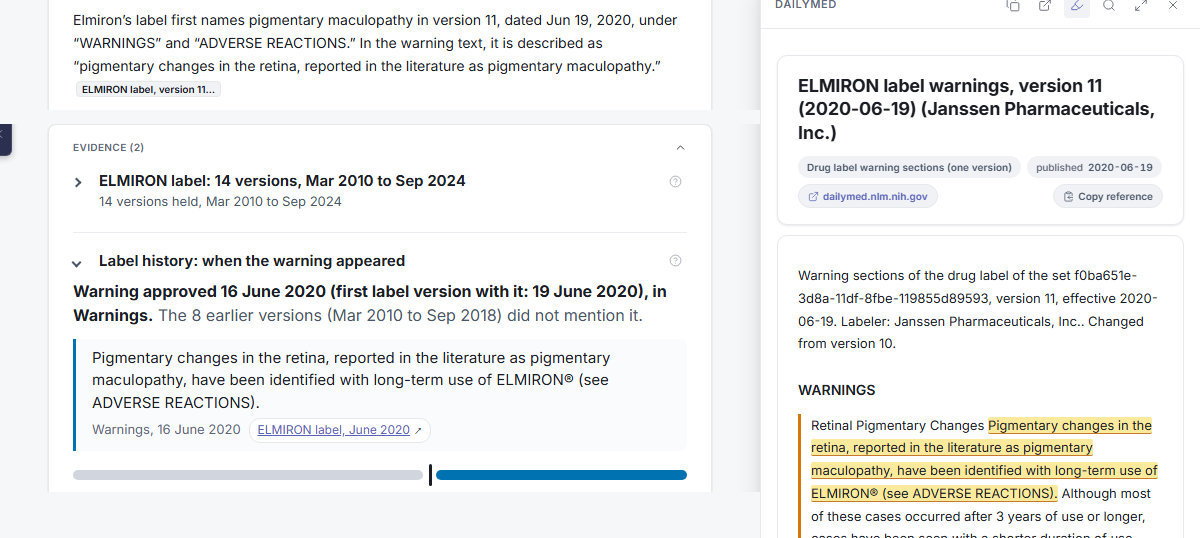
"Show the label history of Elmiron for pigmentary maculopathy: when did the label first name it, and in which section?"
What comes back: "Elmiron's label first names pigmentary maculopathy in version 11, dated Jun 19, 2020, under "WARNINGS" and "ADVERSE REACTIONS."" Click the citation and the label opens beside the answer, headed "ELMIRON label warnings, version 11 (2020-06-19) (Janssen Pharmaceuticals, Inc.)", with the warning sentence highlighted.[1] The answer also says what the record holds: versions from 8 March 2010 to 18 September 2024, with earlier versions not held.
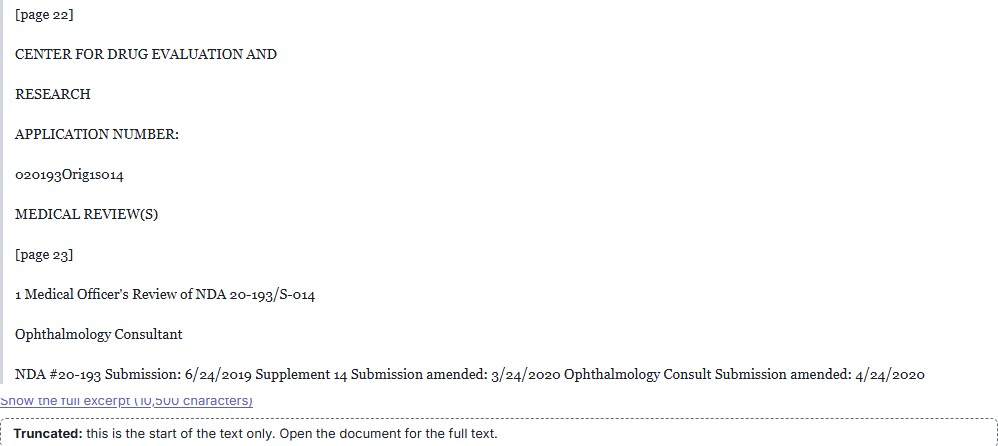
"What did FDA's reviewer record about the Elmiron warning supplement, and with which dates?"
What comes back: the Medical Officer's review of NDA 020193, supplement S-014, which records "NDA #20-193 Submission: 6/24/2019 Supplement 14" and, for the ophthalmology consult, "Review completed: 5/19/2020". FDA approved the supplement on 16 June 2020. Submission, review and approval are three dates, almost a year apart, and each is typed. The Pearce et al. study in Ophthalmology was published online on 22 May 2018.[2]
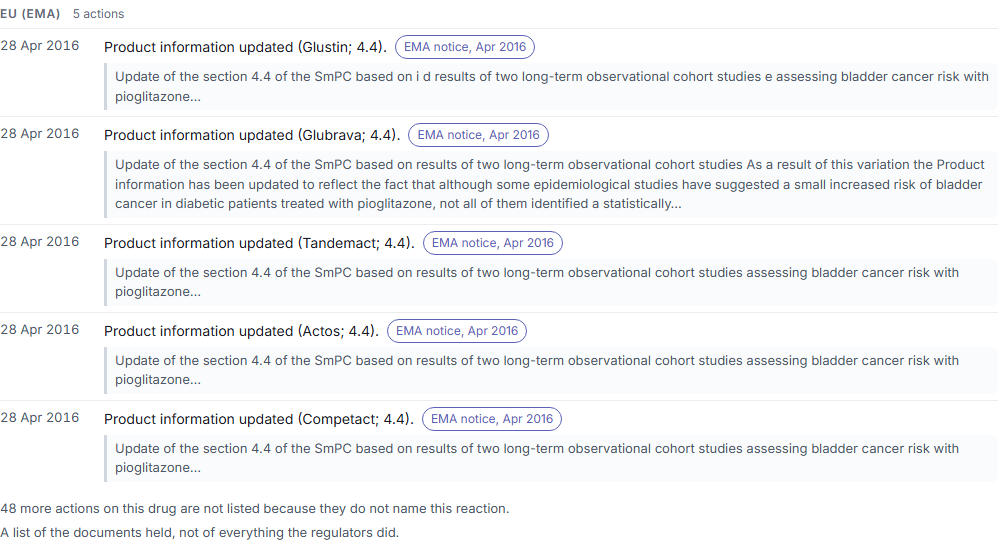
"Did regulators abroad act on pioglitazone and bladder cancer before the US label changed?"
What comes back: MHRA's communication to prescribers of August 2011 and EMA's product-information updates of 28 Apr 2016, each quoted and linked. The answer names the regulators searched ("EMA, MHRA, Health Canada and Swissmedic, but not Japan's PMDA") and the card adds "A list of the documents held, not of everything the regulators did."
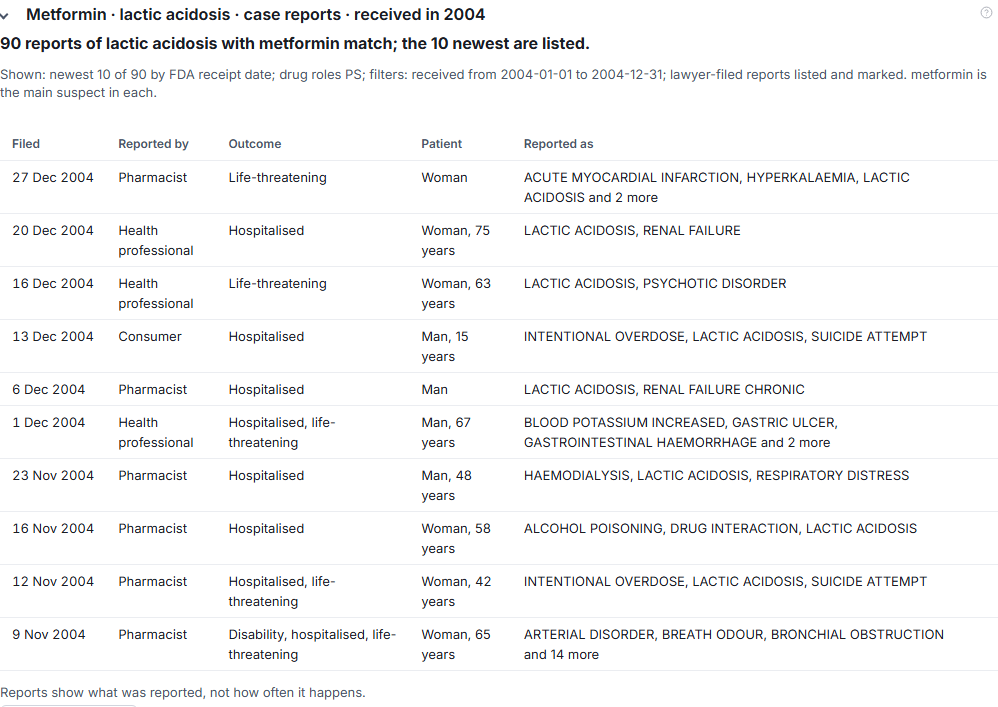
"Show the FAERS reports of lactic acidosis with metformin: the earliest reports and who filed them."
What comes back: the earliest report in the data held ("Jan 4, 2004: case 4057296, filed by a pharmacist"), the reports of that week by case number, and a list with Filed, Reported by, Outcome, Patient and Reported as. Each list ends with "Reports show what was reported, not how often it happens."
When nothing is found
An empty result says what was searched. "Search scope and limits" under each card gives the sources and the period they cover, so "we found no FDA safety communication" can be printed with the search behind it.
What you can check
- The passage behind each statement, opened beside the answer with the supporting text highlighted.
- The kind of each date: published, submitted or approved.
- The data line under each answer, with the FAERS quarter and the snapshot.
- Copy reference in the source panel; Copy or download on each card; Export of the answer as PDF or Word.
Ask for a test link · The Elmiron record, step by step
Sources
- Elmiron label, DailyMed, WARNINGS, "Retinal Pigmentary Changes." https://dailymed.nlm.nih.gov/dailymed/drugInfo.cfm?setid=f0ba651e-3d8a-11df-8fbe-119855d89593
- Pearce WA, Chen R, Jain N. Pigmentary Maculopathy Associated with Chronic Exposure to Pentosan Polysulfate Sodium. Ophthalmology. 2018;125(11):1793-1802. PMID 29801663. https://pubmed.ncbi.nlm.nih.gov/29801663/ (DOI 10.1016/j.ophtha.2018.04.026).