Product-liability insurers and reinsurers
Underwriters ask what the public record says about an insured's products today. Claims teams ask what was knowable on a claimant's dates, and who held the product then. Portfolio teams ask which products and classes gained new evidence since the last review. Each answer below links every item to the FDA, EMA or MHRA document, the label or the study it comes from.
Four questions from underwriting and claims
"Which GLP-1 drugs gained new evidence of pancreatitis in the last 90 days, and did any foreign regulator act first?"
What comes back: an Emerging Evidence watch list, with foreign warnings and their dates. On the Watch lists page, enter a Drug or a Condition, a "Side effect (optional)" and a "Look back" window, then press Start watching. Each check compares the result with the previous one and adds one alert listing the evidence added or removed (a new reporting signal, a new study, a regulator acting abroad, a label change), each linked to its source. The first check sets the baseline.
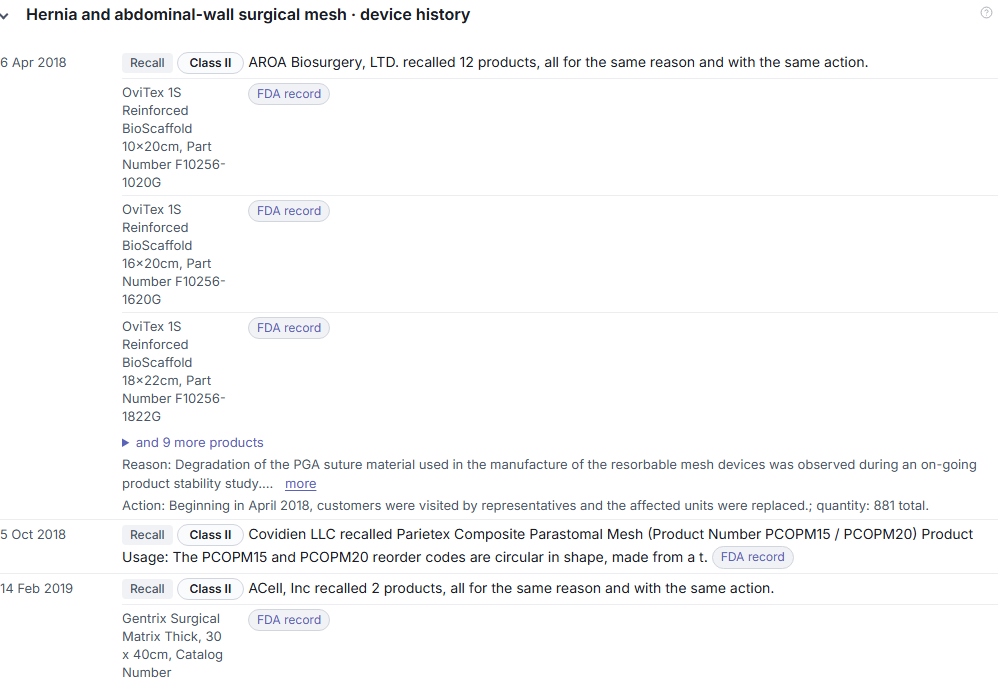
"Surgical mesh migration: what device recalls and adverse event signals exist?"
What comes back: "FDA's recall search returned 150 recall product records for surgical polymeric mesh and seven related mesh categories". The device history card for hernia and abdominal-wall mesh lists up to 60 events by date and class, grouping the products under each recall, so the card is a window onto the record and not a total. It gives the firm's stated reason, the products affected and a link to the FDA record for each. A migration signal needs one product code, so the answer asks which one to check.
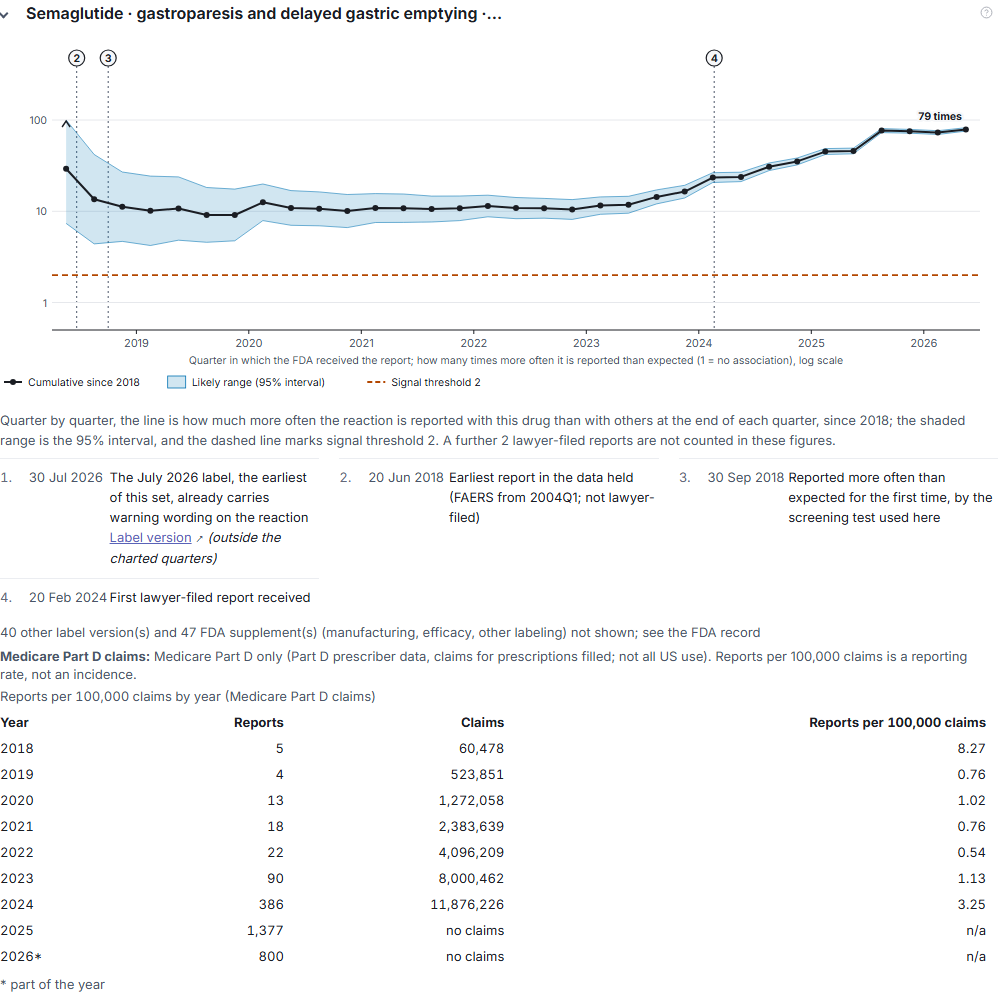
"Is there a disproportionality signal for gastroparesis with semaglutide? Show how it developed over time."
What comes back: "The cumulative PRR first met the stated signal rule on Sep 30, 2018, and was 78.9 by 2026Q2, based on 2,715 non-lawyer reports". Exposure sits under the chart: reports and claims in separate columns by year, with their ratio, from Medicare Part D (2018: 60,478 claims; 2024: 11,876,226) and, separately, from Medicaid. The ratio divides all FAERS reports in the series by the Part D claims, so it is an unmatched descriptive ratio, and the card states that it "is a reporting rate, not an incidence."
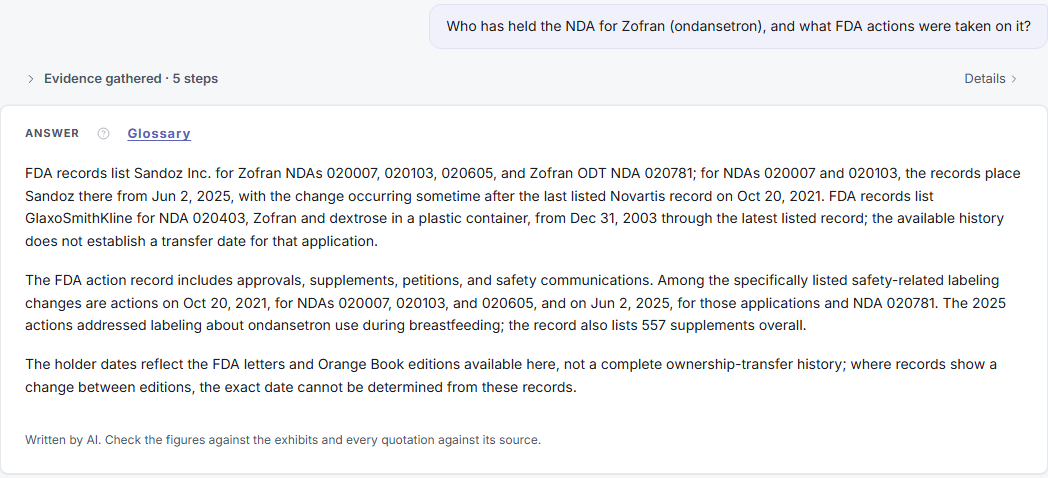
"Who has held the NDA for Zofran (ondansetron), and what FDA actions were taken on it?"
What comes back: each brand application with its holders and their dates, from FDA letters and Orange Book editions: GlaxoSmithKline last observed as holder on 18 Sep 2014; Novartis first observed on 31 Dec 2016 (it took over between 18 Sep 2014 and 31 Dec 2016) and last observed on 20 Oct 2021; Sandoz first observed on 2 Jun 2025. The answer adds the FDA safety-related labeling actions of 20 Oct 2021 and 2 Jun 2025, and states its limit: "The holder dates reflect the FDA letters and Orange Book editions available here, not a complete ownership-transfer history."
What you can check
- The passage behind each statement, opened beside the answer with the supporting text highlighted.
- The kind of each date: published, submitted or approved.
- The data line under each answer, with the FAERS quarter, the snapshot and whether lawyer-filed reports were shown apart or excluded.
- "How this is measured" and "Search scope and limits" under each card.
- Copy or download on each card; Export of the answer as PDF or Word.