Litigation funders
A funder reads a pharmaceutical or device case from outside. Counsel presents it; the funder's team has to test it. Most of that test turns on whether the causation evidence holds, what the label and FDA said at the relevant time, and whether preemption or a Rule 702 challenge could end the case early. Every answer cites the document each statement rests on.
Four questions before a term sheet
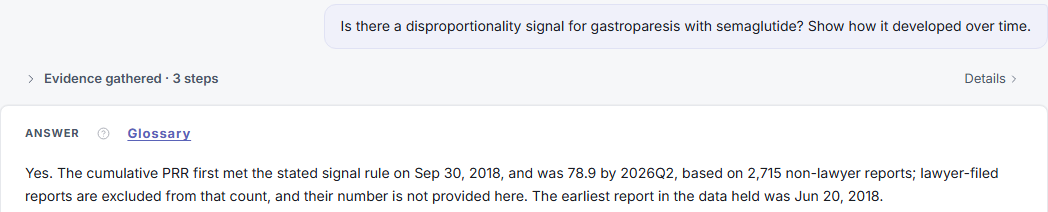
"Does the reporting signal hold with lawyer-filed reports removed, and is there a trial or meta-analysis against it?"
What comes back: the signal recomputed each way, and the studies on both sides. On semaglutide and gastroparesis, the PRR of 78.9 in 2026Q2 rests on "2,715 non-lawyer reports; lawyer-filed reports are excluded from that count."
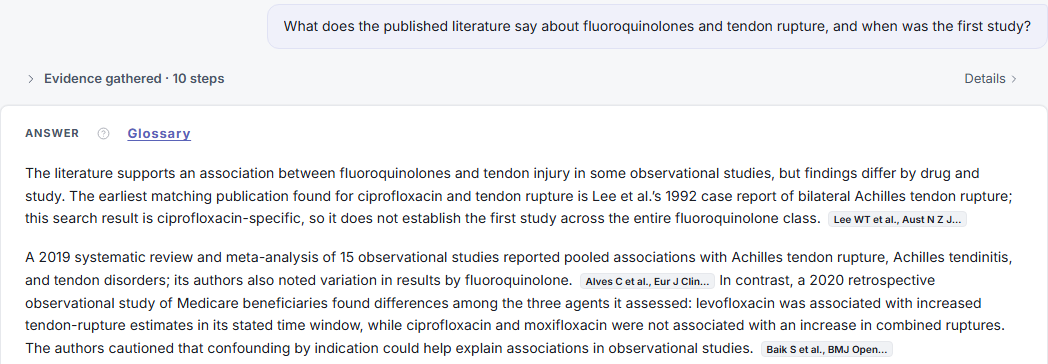
"What does the published literature say about fluoroquinolones and tendon rupture, and when was the first study?"
What comes back: the studies, counted by design (31 studies, 25 case reports, 12 meta-analyses, 4 observational studies), and the findings that cut each way. A 2020 study of Medicare beneficiaries found levofloxacin "associated with increased tendon-rupture estimates in its stated time window, while ciprofloxacin and moxifloxacin were not associated with an increase in combined ruptures."
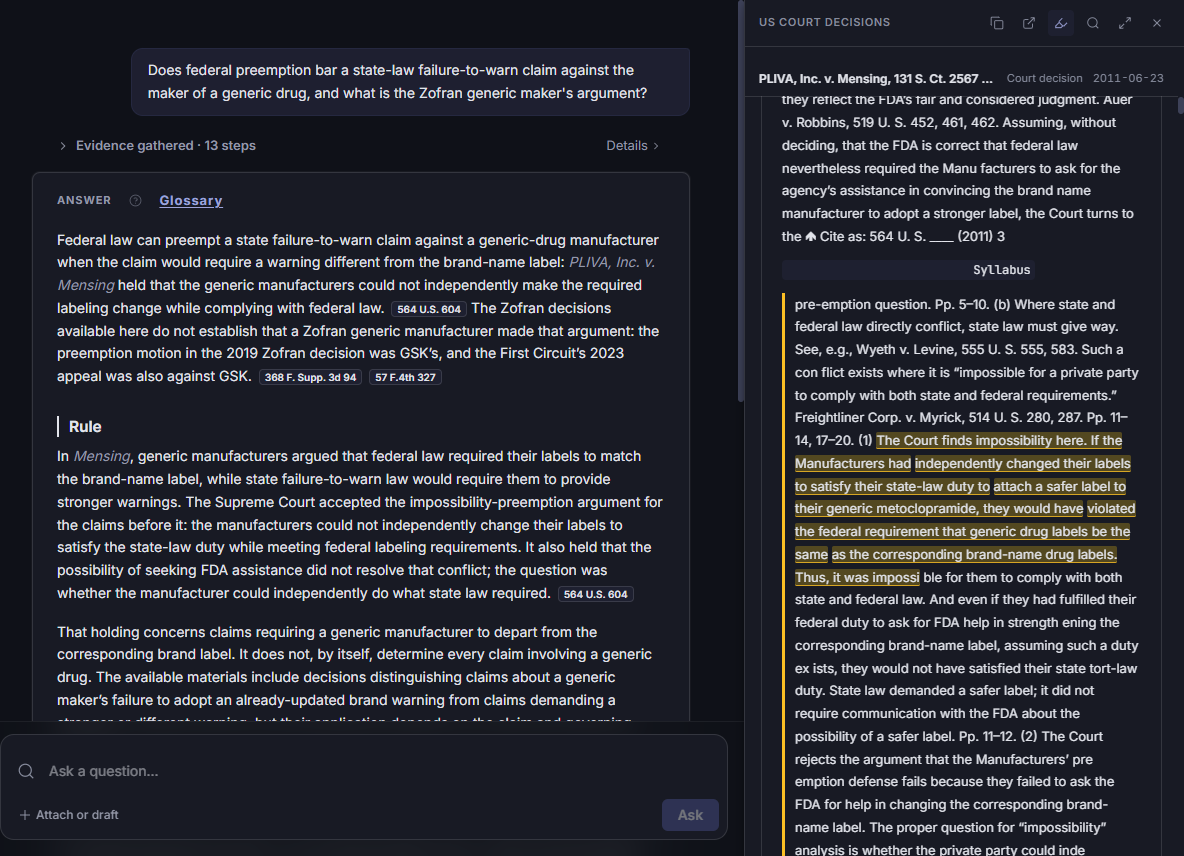
"Does federal preemption bar a state-law failure-to-warn claim against the maker of a generic drug, and what is the Zofran generic maker's argument?"
What comes back: the Mensing rule, and a correction of the question's premise from the Zofran rulings: "the preemption motion in the 2019 Zofran decision was GSK's, and the First Circuit's 2023 appeal was also against GSK" (368 F. Supp. 3d 94; 57 F.4th 327).
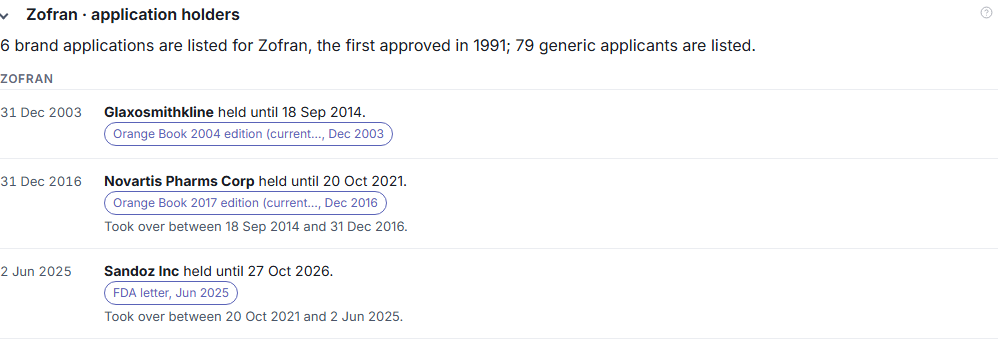
"Who has held the NDA for Zofran (ondansetron), and what FDA actions were taken on it?"
What comes back: "6 brand applications are listed for Zofran, the first approved in 1991; 79 generic applicants are listed", each holder dated from an FDA letter or Orange Book edition. Brand applications and generic applicants are listed apart, which is the line Mensing draws.
The defenses that can end a case early
Wyeth v. Levine held that federal law did not preempt a failure-to-warn claim where the manufacturer could have strengthened the warning under FDA's "changes being effected" process.[1] Merck Sharp & Dohme Corp. v. Albrecht held that a manufacturer asserting preemption must show it fully informed FDA of the reasons for the warning and that FDA told it the agency would not approve the change, and that a judge decides.[2] PLIVA, Inc. v. Mensing held that state-law failure-to-warn claims that would have required a generic manufacturer to change its label on its own were preempted, because a generic label must match the brand-name label.[3] For devices, Class III products approved through premarket approval face a statutory bar on state requirements different from or additional to the federal ones.[4][5] Causation experts face Rule 702: the proponent must show it is more likely than not that the opinion rests on sufficient facts or data and reliable methods, reliably applied.[6]
What you can check
- The passage behind each statement, opened beside the answer with the supporting text highlighted.
- The kind of each date: published, submitted or approved.
- How the reports are counted: one report per FAERS case id, lawyer-filed reports flagged, and likely duplicates found by record linkage and shown as a check on how the measures move without them.
- "How this is measured" and "Search scope and limits" under each card.
- The Expert pack: exhibits, a methods appendix and a command that reruns the eligible snapshot-backed calculations and lists the exhibits it cannot verify. Export as PDF or Word.
Sources
- Wyeth v. Levine, 555 U.S. 555 (2009), decided March 4, 2009. https://www.law.cornell.edu/supremecourt/text/06-1249
- Merck Sharp & Dohme Corp. v. Albrecht, 587 U.S. 299 (2019), decided May 20, 2019. https://www.law.cornell.edu/supremecourt/text/17-290
- PLIVA, Inc. v. Mensing, 564 U.S. 604 (2011), decided June 23, 2011. https://www.law.cornell.edu/supct/html/09-993.ZO.html
- 21 U.S.C. § 360k(a). https://www.law.cornell.edu/uscode/text/21/360k
- Riegel v. Medtronic, Inc., 552 U.S. 312 (2008), decided February 20, 2008. https://www.law.cornell.edu/supct/html/06-179.ZO.html
- Federal Rule of Evidence 702. https://www.law.cornell.edu/rules/fre/rule_702