Defense firms
A defense team rebuilds the regulatory record: what FDA's reviewers wrote, what the company submitted and when, what the label said at each point. Then it tests the plaintiff's causation evidence, starting with the adverse-event reports and the studies. Plaintiff firms ask the same questions of the same sources.
Five questions from the defense side
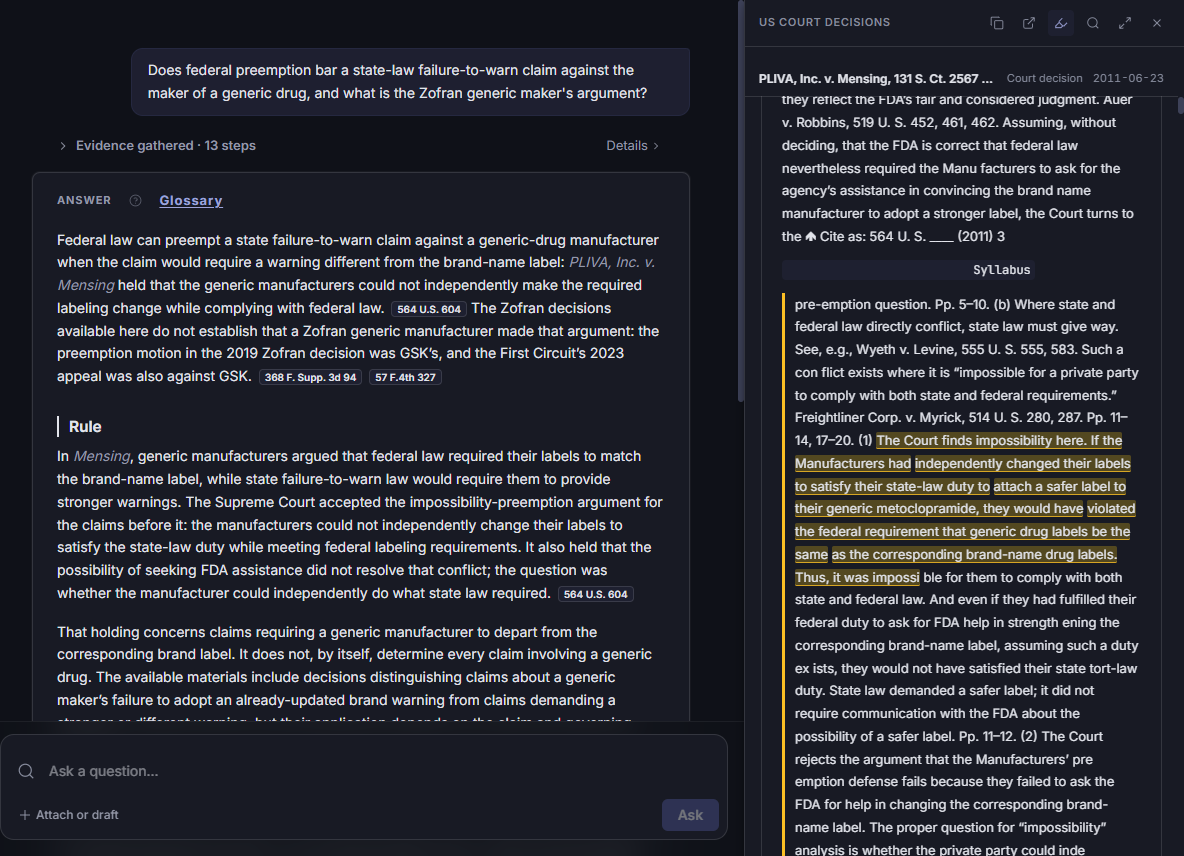
"Does federal preemption bar a state-law failure-to-warn claim against the maker of a generic drug, and what is the Zofran generic maker's argument?"
What comes back: the Mensing rule, cited to 564 U.S. 604, and a correction of the premise: "The Zofran decisions available here do not establish that a Zofran generic manufacturer made that argument: the preemption motion in the 2019 Zofran decision was GSK's, and the First Circuit's 2023 appeal was also against GSK" (368 F. Supp. 3d 94; 57 F.4th 327). The panel beside it opens the Mensing syllabus, headed US COURT DECISIONS, Court decision, 2011-06-23, with the holding highlighted.
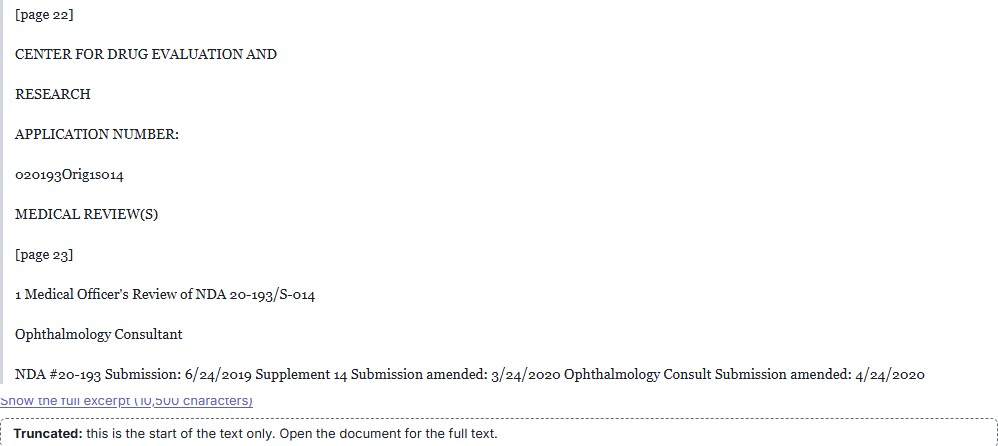
"What did FDA's reviewers write about pigmentary maculopathy with Elmiron, and when was the warning proposed, reviewed and approved?"
What comes back: the Medical Officer's review of NDA 020193, supplement S-014, quoted by page, with the dates typed: the company's submission of 24 June 2019, the ophthalmology consult's "Review completed: 5/19/2020" and FDA's approval of 16 June 2020. The answer also gives the limits of the evidence it holds, such as "reports cannot prove cause". It does not weigh the claim or the defense.
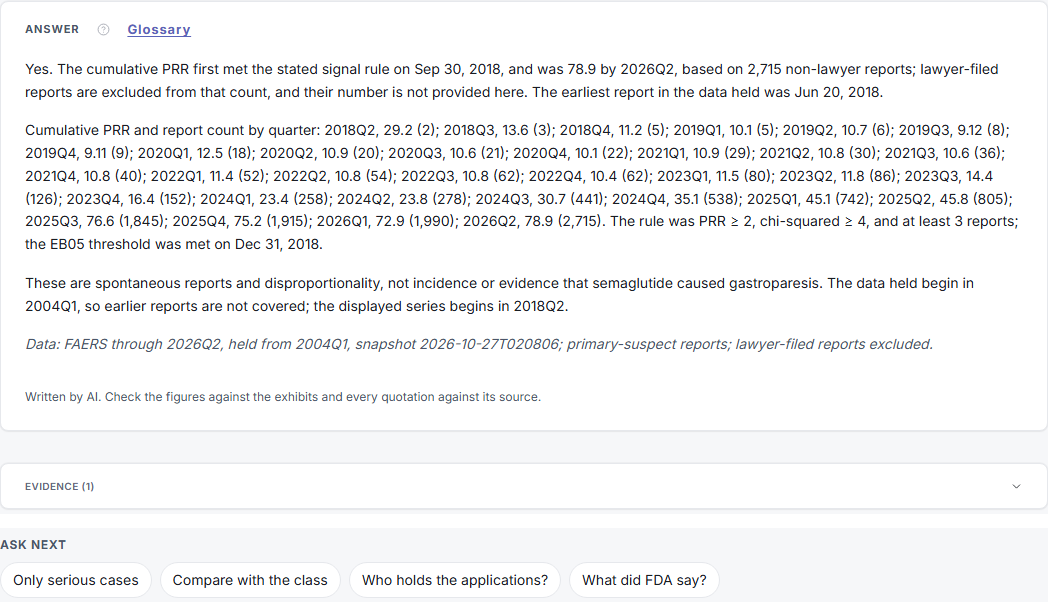
"Is there a disproportionality signal for gastroparesis with semaglutide? Show how it developed over time."
What comes back: "The cumulative PRR first met the stated signal rule on Sep 30, 2018, and was 78.9 by 2026Q2, based on 2,715 non-lawyer reports." The answer states the rule ("PRR ≥ 2, chi-squared ≥ 4, and at least 3 reports"), the date the EB05 threshold was met (31 December 2018), and the PRR for every quarter in between. It also states the limit: "These are spontaneous reports and disproportionality, not incidence or evidence that semaglutide caused gastroparesis." Ask next offers "Only serious cases" and "Compare with the class".
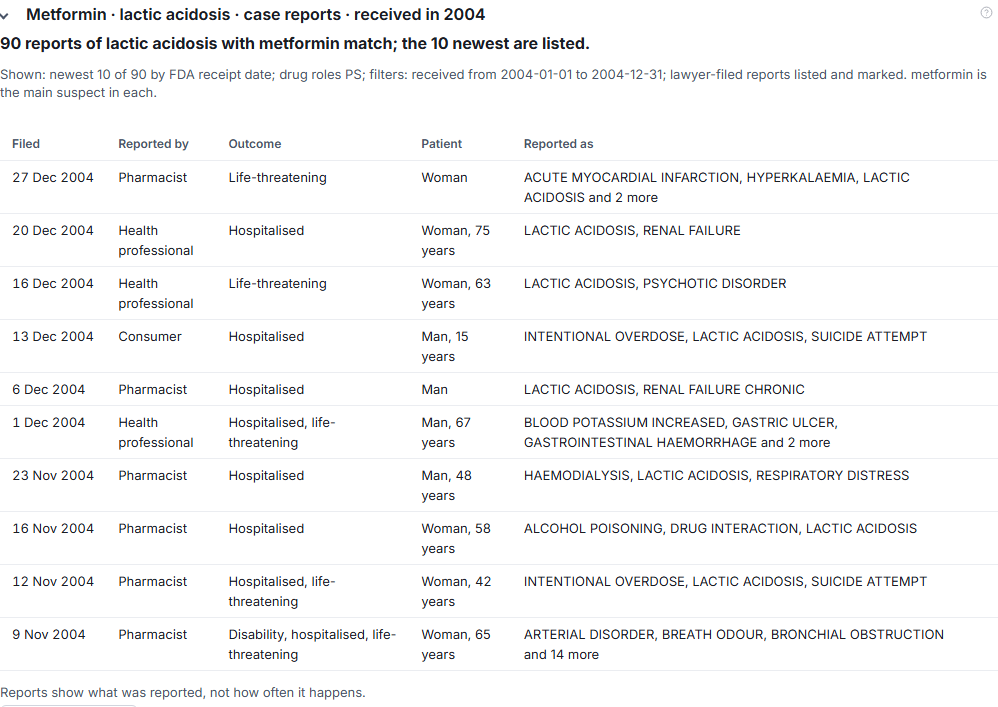
"Show the FAERS reports of lactic acidosis with metformin: the earliest reports and who filed them."
What comes back: the earliest report in the data held, "dated Jan 4, 2004: case 4057296, filed by a pharmacist", the other reports of that week by case number and reporter, and the lawyer-filed count: "five lawyer-filed reports appear among the 19,031 matching reports across all dates". The report list gives Filed, Reported by, Outcome, Patient and Reported as for each report.
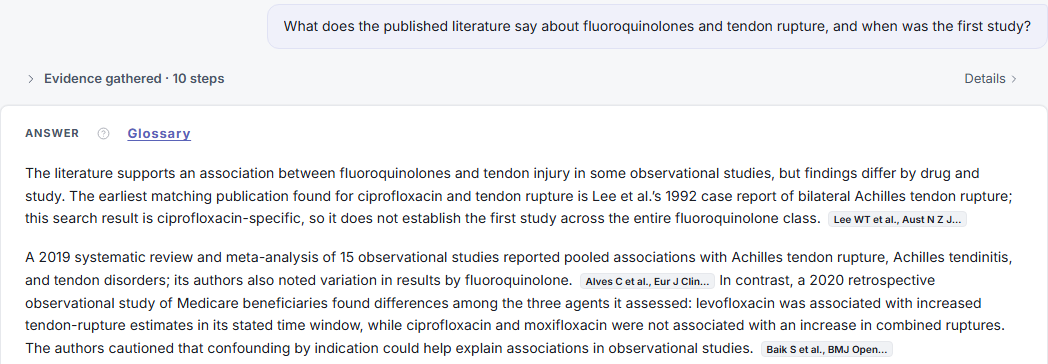
"What does the published literature say about fluoroquinolones and tendon rupture, and when was the first study?"
What comes back: the studies on both sides. For a 2020 retrospective study of Medicare beneficiaries (Baik et al., BMJ Open), the answer reports that "levofloxacin was associated with increased tendon-rupture estimates in its stated time window, while ciprofloxacin and moxifloxacin were not associated with an increase in combined ruptures", and that its authors "cautioned that confounding by indication could help explain associations in observational studies."
Duplicates and lawyer-filed reports
Counts are one report per FAERS case id. Likely duplicates across case ids are found by probabilistic record linkage (Fellegi-Sunter, the method behind WHO-UMC's vigiMatch) and shown as a check: how PRR, ROR, IC and EBGM move without them. Lawyer-filed reports are flagged, and a signal can be shown with and without them.
The rules this record serves
Under Merck Sharp & Dohme Corp. v. Albrecht, a manufacturer asserting preemption must show that it fully informed FDA of the reasons for the warning and that FDA told it the agency would not approve the change, and the judge decides.[1] Wyeth v. Levine pointed to the "changes being effected" process, which lets a manufacturer add or strengthen a warning without prior approval,[2] for newly acquired information, defined as data, analyses or other information not previously submitted to FDA, where the evidence of a causal association meets the standard for including the warning in the label.[3][4] PLIVA, Inc. v. Mensing held that state-law failure-to-warn claims that would have required a generic manufacturer to change its label on its own were preempted.[5] For devices, 21 U.S.C. § 360k bars state requirements different from or additional to federal ones, and Riegel v. Medtronic applied it to Class III devices approved through premarket approval.[6][7]
On causation, Rule 702 requires the proponent to show it is more likely than not that the expert's opinion rests on sufficient facts or data and reliable methods, reliably applied.[8]
What you can check
- The passage behind each statement, opened beside the answer, including FDA's own words in its reviews.
- The kind of each date: published, submitted or approved.
- The data line under each answer: "Data: FAERS through 2026Q2, held from 2004Q1, snapshot 2026-10-27T020806; primary-suspect reports; lawyer-filed reports excluded."
- "How this is measured" and "Search scope and limits" under each card.
- The Expert pack: exhibits, a methods appendix and a command that reruns the eligible snapshot-backed calculations and lists the exhibits it cannot verify. Export as PDF or Word.
Sources
- Merck Sharp & Dohme Corp. v. Albrecht, 587 U.S. 299 (2019), decided May 20, 2019. https://www.law.cornell.edu/supremecourt/text/17-290
- Wyeth v. Levine, 555 U.S. 555 (2009), decided March 4, 2009. https://www.law.cornell.edu/supremecourt/text/06-1249
- 21 CFR 314.70(c)(6)(iii)(A). https://www.law.cornell.edu/cfr/text/21/314.70
- 21 CFR 314.3(b), "Newly acquired information." https://www.law.cornell.edu/cfr/text/21/314.3
- PLIVA, Inc. v. Mensing, 564 U.S. 604 (2011), decided June 23, 2011. https://www.law.cornell.edu/supct/html/09-993.ZO.html
- 21 U.S.C. § 360k(a). https://www.law.cornell.edu/uscode/text/21/360k
- Riegel v. Medtronic, Inc., 552 U.S. 312 (2008), decided February 20, 2008. https://www.law.cornell.edu/supct/html/06-179.ZO.html
- Federal Rule of Evidence 702. https://www.law.cornell.edu/rules/fre/rule_702