From a question to the cited page
Write the drug, the reaction and what you need to know, as you would put it to a colleague. "Metformin and lactic acidosis: label history and the first signal" gets a sharper answer than "is metformin dangerous". Kelsey answers from 31 public sources, checked by a nightly pipeline whose refresh schedule varies by source, and puts a citation pill after each statement.
The answer, and the page it came from
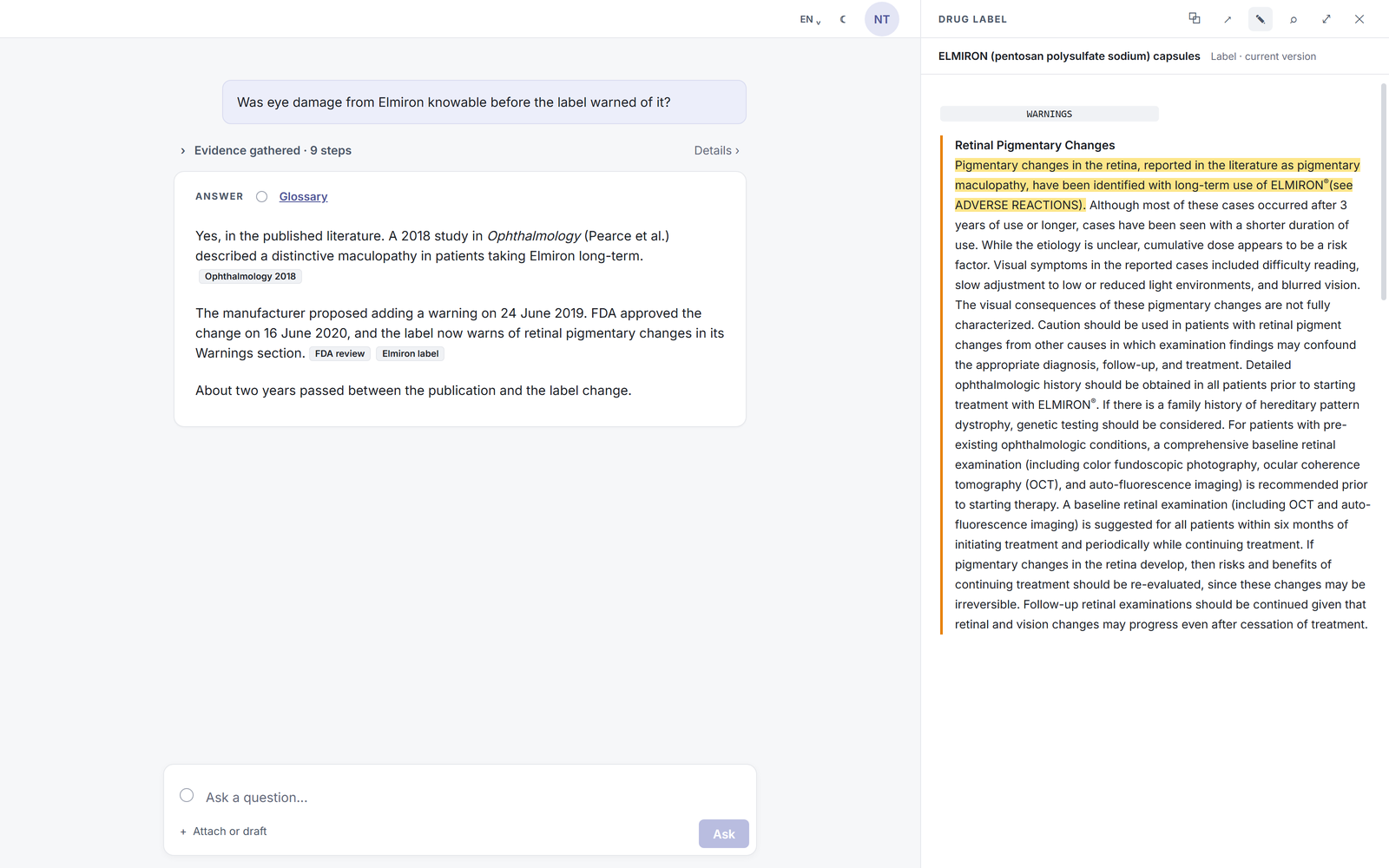
Was eye damage from Elmiron knowable before the label warned of it?
What comes back: "Yes, in the published literature." The answer cites three documents: a 2018 study in Ophthalmology (Pearce et al.), FDA's review of the manufacturer's proposal of 24 June 2019, and the Elmiron label after FDA's approval of 16 June 2020. Clicking "Elmiron label" opens the label's WARNINGS section on the right, with the Retinal Pigmentary Changes sentence highlighted.
Above the answer, "Evidence gathered · 9 steps" lists each search and lookup the answer ran. Under every answer: "Written by AI. Check the figures against the exhibits and every quotation against its source."
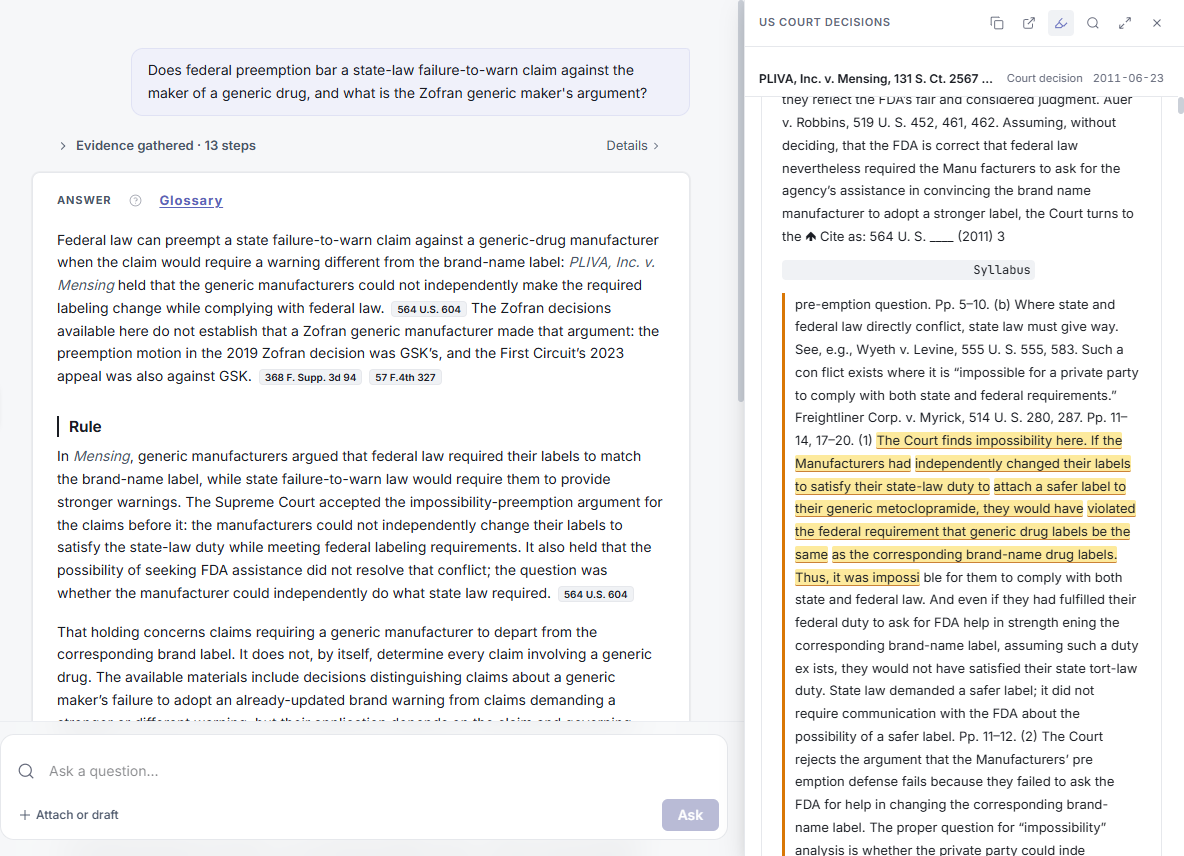
Each statement ends in a citation pill, such as 564 U.S. 604. Clicking the pill opens the document in the right panel, with the supporting passage highlighted. The panel header gives the source family (US COURT DECISIONS), the document (PLIVA, Inc. v. Mensing), its type (Court decision) and its date (2011-06-23). The Glossary link above the answer explains each term the answer uses.
Hover a pill to read the passage
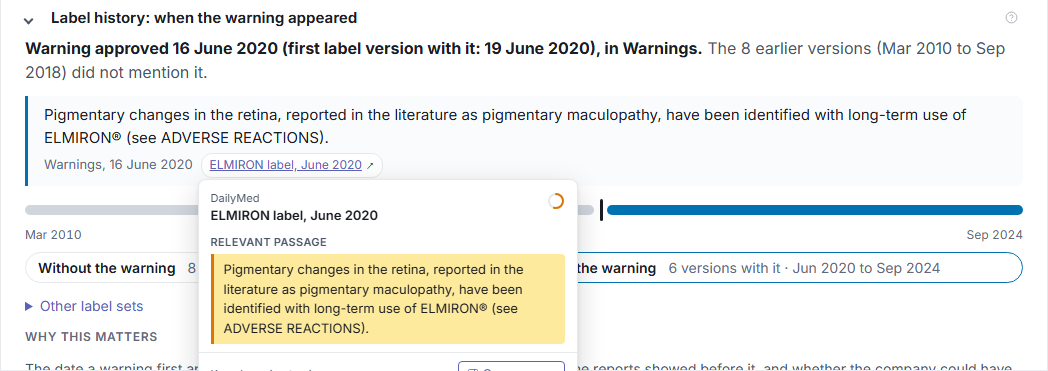
Hovering "ELMIRON label, June 2020" shows the source (DailyMed), the document and the RELEVANT PASSAGE. "Open source" pins the document in the right panel.
Label versions, with their dates
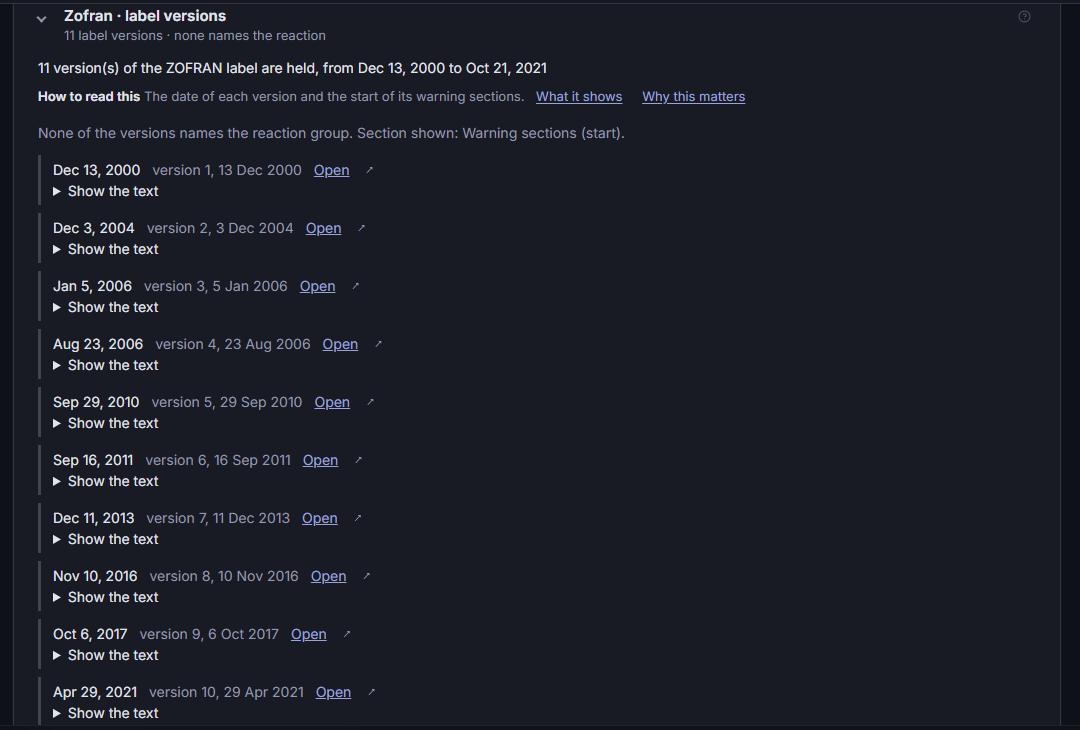
Asking about a label brings up one card listing the versions held, each with its date and an Open link to the DailyMed or Drugs@FDA source. "Show the text" expands that version's warning sections. Under "How to read this", the card says what it shows and why it matters for the question. For Zofran: 11 versions, 13 December 2000 to 21 October 2021, and none names the reaction asked about. See Label history.
Who held the application
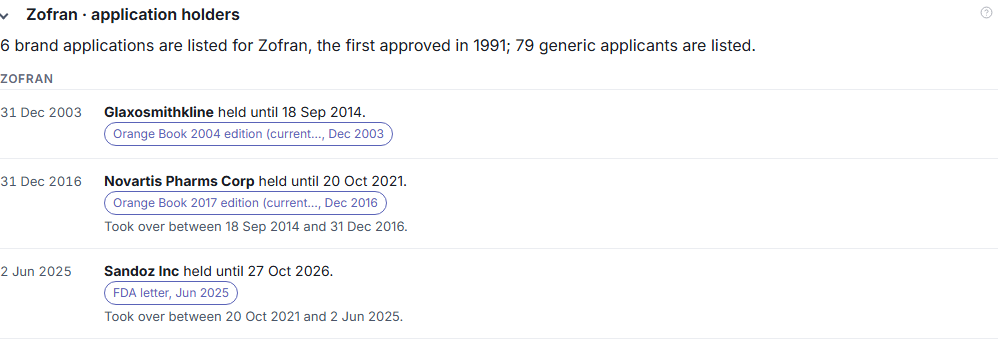
For each brand application, the holders card lists the holders with the dates on which each is first and last observed, each dated from an FDA letter or an Orange Book edition. For Zofran: "6 brand applications are listed for Zofran, the first approved in 1991; 79 generic applicants are listed." GlaxoSmithKline is last observed as holder of the first on 18 Sep 2014, then Novartis, then Sandoz, and the card gives the interval in which each change happened ("Took over between 18 Sep 2014 and 31 Dec 2016"). Generic applicants follow, each with its approval date.
The card reports what FDA letters and Orange Book editions record. It does not establish who owned the product on a given day. Brand applications and generic applicants are listed apart because, under PLIVA, Inc. v. Mensing, a generic maker's label has to match the brand's.[1]
The signal, and the reports under it
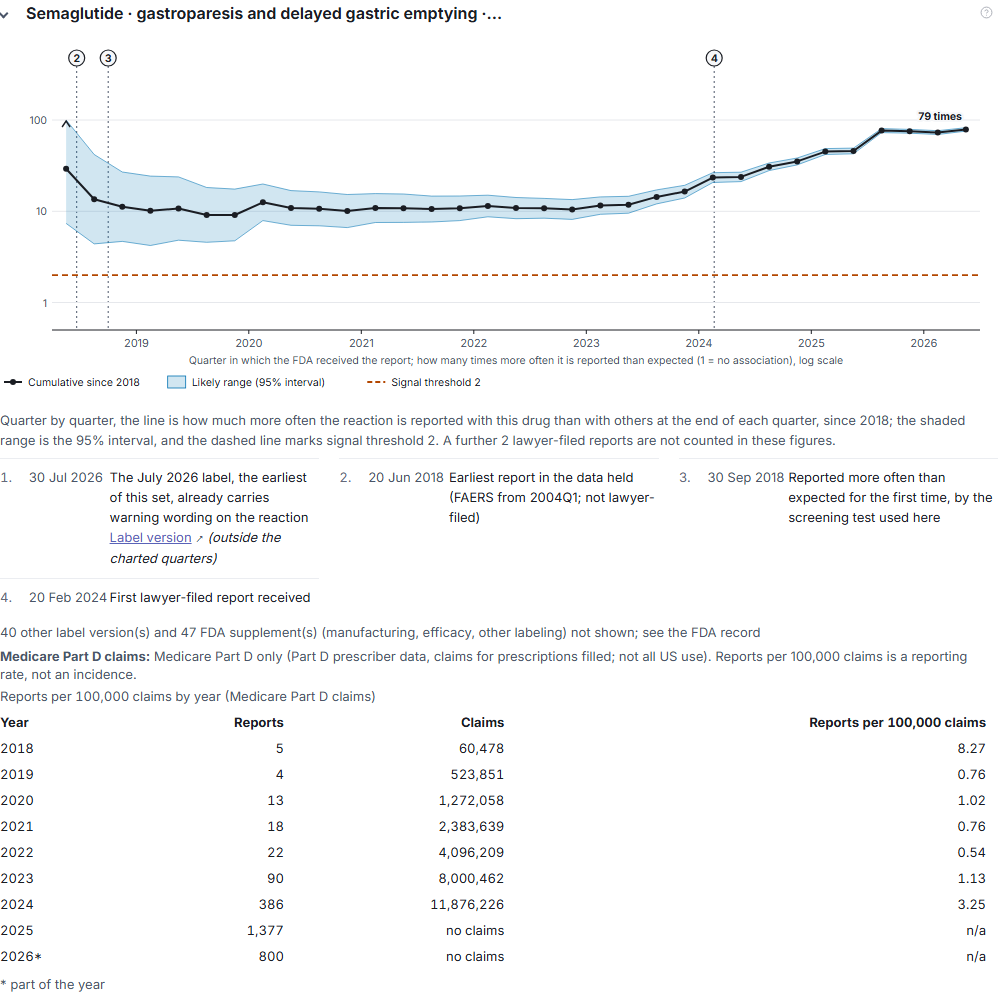
The signal card gives, for one drug and one reaction, the PRR, ROR, IC and EBGM, each with its interval (95% for PRR, ROR and IC; EB05 to EB95, a 90% interval, for EBGM), and whether the reports meet the signal threshold. Semaglutide and gastroparesis: "The cumulative PRR first met the stated signal rule on Sep 30, 2018, and was 78.9 by 2026Q2, based on 2,715 non-lawyer reports." The chart plots the cumulative PRR by quarter with the 95% interval and signal threshold 2. It is a retrospective calculation on the current snapshot, with each case counted from the date FDA first received it. Numbered markers date the earliest report, the first quarter in which the screening test was met and the first lawyer-filed report. Medicare Part D claims and Medicaid prescriptions sit in two separate tables, with reports and claims in separate columns. The reports are the general FAERS series, so the ratio between them is unmatched and descriptive.
Lawyer-filed reports are counted outside the measures, and the card gives their number: "A further 2 lawyer-filed reports are not counted in these figures." "How this is measured" opens the method.
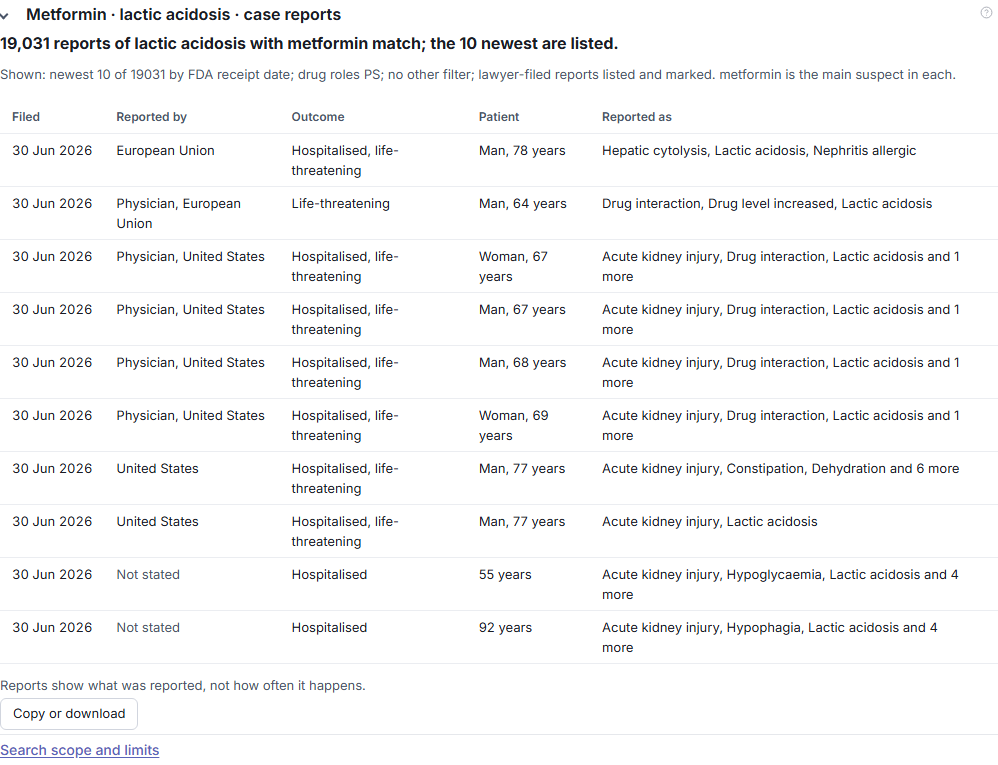
The report list gives, for each report, the filing date, the reporter, the outcome, the patient and the reaction terms as reported, and links to the report. Other report views: reports per quarter with label versions and FDA supplements marked; time to onset, age, sex and dechallenge; comparison with other drugs in the class; for a drug with no reaction named, every reaction ranked, with whether the label names it.
A defense expert will raise duplicates. Counts are one report per FAERS case id. Kelsey finds likely duplicates across case ids by record linkage, the method behind WHO-UMC's vigiMatch, and shows how the measures move without them.
A memo, and the evidence it rests on
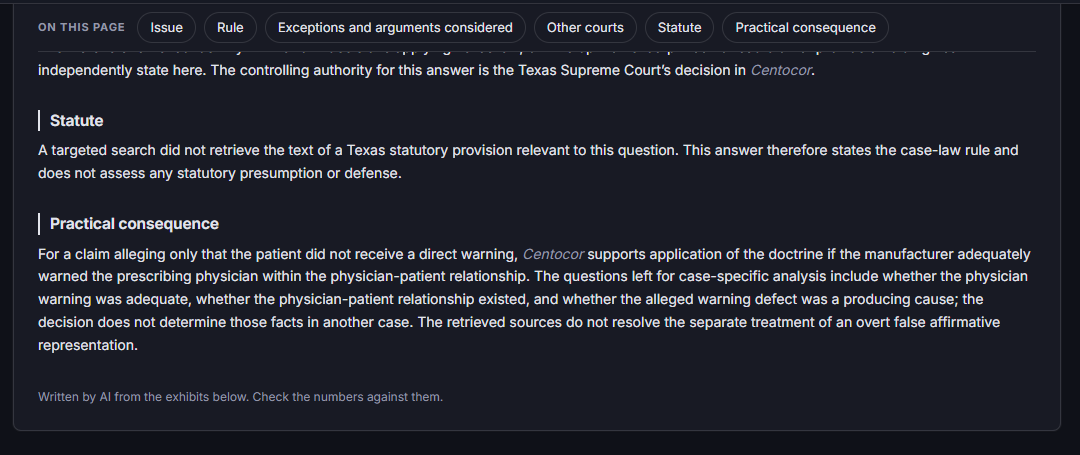
A legal question gets a memo with an On this page bar: Issue, Rule, Exceptions and arguments considered, Other courts, Statute, Practical consequence. If a search found nothing, the memo says so and limits its conclusion. Here no Texas statute was retrieved, so the memo states the case-law rule from Centocor and does not assess a statutory presumption.
Under the memo: "Written by AI from the exhibits below. Check the numbers against them." Then the exhibits (Evidence (5)), the Expert pack and Export.
The Expert pack
The Expert pack is a zip that holds:
exhibits.json: every card in the answer, each stamped with its data snapshot, code version and method version- the methods appendix, in Markdown and PDF
VERIFY.md: the command that reruns the eligible snapshot-backed calculations on the same snapshot and lists the exhibits it cannot verify, such as documents, literature and case law. It needs the code at the version named in the appendix and the data snapshot
You can also export the answer as PDF or Word, or ask Kelsey to draft a memo or an email from the evidence on screen. You edit the draft in the app and download it as Word on your firm's letterhead.
The evidence assessment
For a failure-to-warn question, the Evidence assessment card sets out the dated facts in five rows: Notice, Label adequacy, Ability to change the label, Responsible holder and Causation support. Each row gives the finding and its basis. For Elmiron the dated facts are: Pearce et al. published online on 22 May 2018; the company's submission proposing a warning on 24 June 2019; FDA's approval on 16 June 2020. The row on the ability to change the label cites 21 CFR 314.70(c)(6)(iii) and 21 CFR 314.3. The card sets out sources and dates. It does not determine a legal notice date, weigh the strength of a claim or a defense, or show that a report was caused by a drug; counsel does that.
Calculated figures name their data

The "Method and runs" card states the data behind every card in the answer: "FAERS through 2026Q2, held from 2004Q1; snapshot 27 Oct 2026", with the dates of the PubMed, documents and ClinicalTrials.gov data. See Exports and reports.
Watch lists
Choose a drug or a condition, optionally a side effect, and a look-back window, then press Start watching. Each check compares the result with the previous one and adds one alert listing the evidence added or removed: a new reporting signal, a new study, a regulator acting abroad, or a label change. The first check sets the baseline. Each alert links to its source. See Watch lists.
What every answer shows
| On screen | What it tells you |
|---|---|
| The highlighted passage | The exact words behind the statement |
| The date type: published, submitted, approved, or "public from" | When FDA had a document, and when anyone else could see it |
| The query run and snapshot | How to rerun the count |
| The sources searched, with their periods | What was searched when nothing was found |
| "Earliest public evidence found … (searched completely)" | That nothing earlier exists in that source |
| "Earlier public evidence found … so an earlier one may exist" | That the source was only partly searched |
By source
| Page | What it shows |
|---|---|
| Adverse event reports | The signal quarter by quarter, the case reports, lawyer-filed reports apart, the Duplicate Check |
| Label history | The label versions held, the warning date, the warning text |
| FDA reviews and decisions | Approval reviews quoted by page, supplements, safety communications, labeling changes |
| Studies and trials | PubMed by year and study type, trial results, EMA, MHRA, Health Canada and Swissmedic actions |
| Devices | Recalls with FDA's class, MAUDE reports, 510(k) and PMA routes |
| Law and case law | Court decisions, 21 CFR by date, the current FDCA, four state product-liability statutes |
| Watch lists | A saved question and its alerts |
| Exports and reports | PDF, Word, CSV, PNG and the Expert pack |
What is loaded
- 21 million FDA adverse-event reports, FAERS and its predecessor AERS, from 2004
- 650,000 searchable documents
- 60,000+ studies, with PubMed searched live for each drug
Anything missing from the stored data is fetched live from PubMed, DailyMed and ClinicalTrials.gov. Kelsey is a working product, and test links are available on request: Ask for a test link.
Sources
- PLIVA, Inc. v. Mensing, 564 U.S. 604 (2011), decided June 23, 2011. https://www.law.cornell.edu/supct/html/09-993.ZO.html