Devices
Kelsey holds MAUDE device reports, FDA's 510(k) and PMA decisions, device recalls, product classifications and GUDID device identifiers. MAUDE takes reports from manufacturers, importers and device user facilities, which must report, and from health care professionals, patients and consumers, who may.[1]
Device history
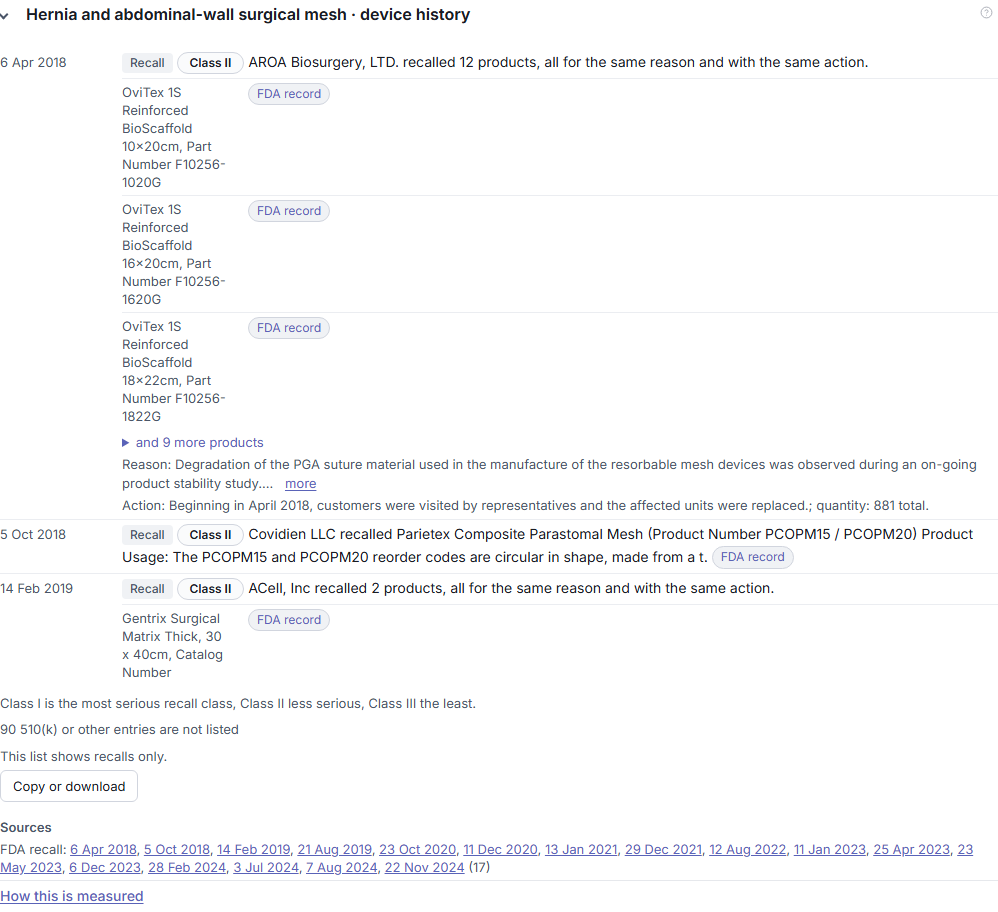
The card for hernia and abdominal-wall surgical mesh lists up to 60 events, so it is a window onto FDA's record, not a total: the count of matching recall product records is a separate figure, given in the answer, as in the example below. Products are grouped under their recall. Each recall carries its date, FDA's class and an FDA record link for every product recalled. The first reads:
6 Apr 2018 · Recall · Class II · AROA Biosurgery, LTD. recalled 12 products, all for the same reason and with the same action.
Under it, each product with its part number (OviTex 1S Reinforced BioScaffold 10×20cm, Part Number F10256-1020G), the reason ("Degradation of the PGA suture material used in the manufacture of the resorbable mesh devices was observed during an on-going product stability study") and the action, ending "quantity: 881 total". The card closes with "Class I is the most serious recall class, Class II less serious, Class III the least" and links each recall date to FDA's record.
When the question is too broad
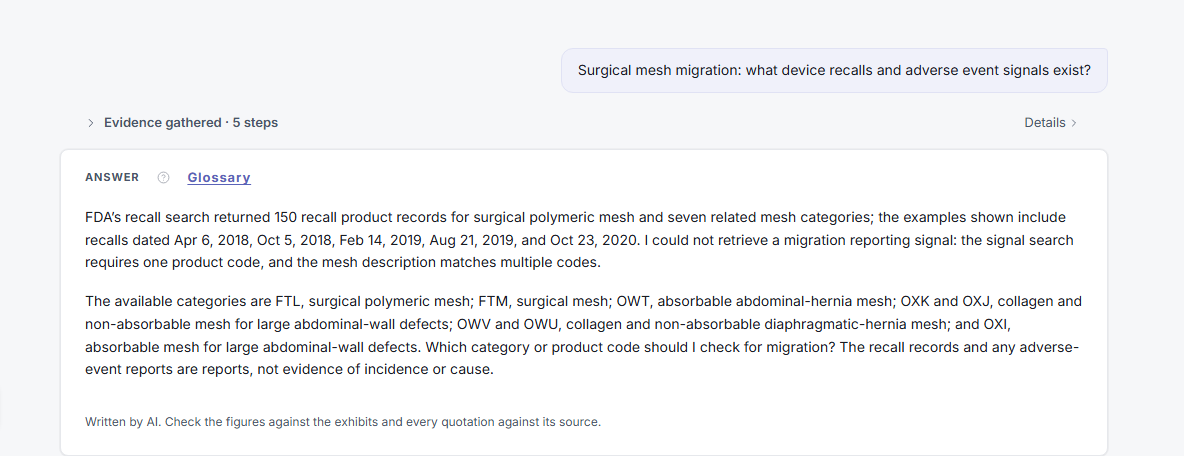
Surgical mesh migration: what device recalls and adverse event signals exist?
What comes back: "FDA's recall search returned 150 recall product records for surgical polymeric mesh and seven related mesh categories." For the signal, the answer says what stopped it: "the signal search requires one product code, and the mesh description matches multiple codes." It lists the codes (FTL, surgical polymeric mesh; FTM, surgical mesh; OWT, absorbable abdominal-hernia mesh; and others) and asks which one to check.
Reported problems against the product-code family
For one product code, the device signal card sets the share of each reported problem against its share in the rest of the codes under the same regulation, as a PRR with its 95% interval. When one filer sent more than half of a problem's reports, the card flags it and gives the PRR without that filer.
Approval route
The approval route card shows whether FDA cleared the device through a 510(k) or approved it through premarket approval (PMA),[2] with each decision, applicant and date, and for PMA devices the later supplements. Under each route, a note on how courts have treated it for preemption, citing Riegel v. Medtronic and Medtronic v. Lohr.
What device reports cannot show
Reports do not show how many devices were in use, and a report is not a finding of cause. FDA notes that MAUDE may not include reports made under exemptions, variances or alternative reporting requirements granted before June 2019.[1]
Example questions
What was reported to FDA about this device before the recall?
What comes back: The reports with their dates, the recall with its date and class, and the order between them.
Which device warnings and recalls came before this incident?
What comes back: The recalls and warnings on the device in date order, each linked to FDA's record.
Sources
- FDA, "MAUDE - Manufacturer and User Facility Device Experience," https://www.accessdata.fda.gov/scripts/cdrh/cfdocs/cfmaude/search.cfm
- FDA, "Premarket Notification 510(k)," https://www.fda.gov/medical-devices/premarket-submissions-selecting-and-preparing-correct-submission/premarket-notification-510k; FDA, "Premarket Approval (PMA)," https://www.fda.gov/medical-devices/premarket-submissions-selecting-and-preparing-correct-submission/premarket-approval-pma