M&A, licensing and investment diligence
A deal team buying a company, licensing a product or taking a position in a drug maker needs each product's safety history: whether evidence built up before any public action, how regulators at home and abroad responded, and who held the application when. A product can sit under several names and several owners over its life. The record keeps one drug together under every brand, generic and company name.
Five questions on a target's products
"Across the drugs this company holds, where did evidence build up before any public safety action?"
What comes back: product by product, the evidence and its dates.
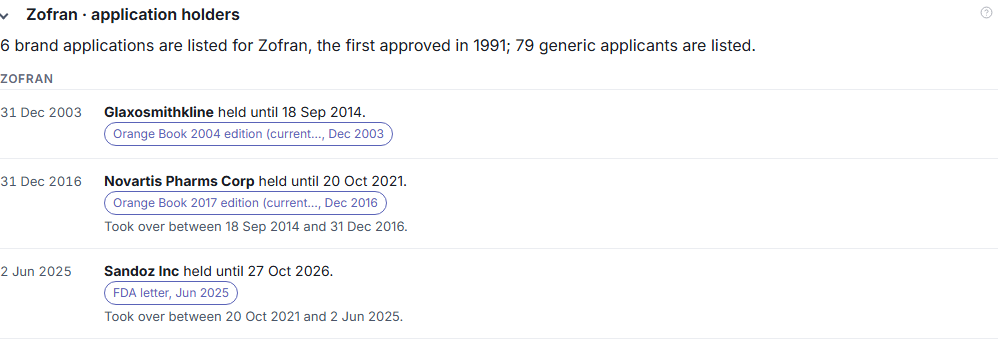
"Who has held the NDA for Zofran (ondansetron), and what FDA actions were taken on it?"
What comes back: the chain of holders for each brand application, dated from FDA letters and Orange Book editions: GlaxoSmithKline, last observed as holder on 18 Sep 2014; Novartis, first observed on 31 Dec 2016 ("Took over between 18 Sep 2014 and 31 Dec 2016") and last observed on 20 Oct 2021; Sandoz, first observed on 2 Jun 2025 ("Took over between 20 Oct 2021 and 2 Jun 2025"). The dates are those of the records, not of the transfers. Then "79 generic applicants (current)", each with its approval date. The answer says where the record stops: "where records show a change between editions, the exact date cannot be determined from these records."
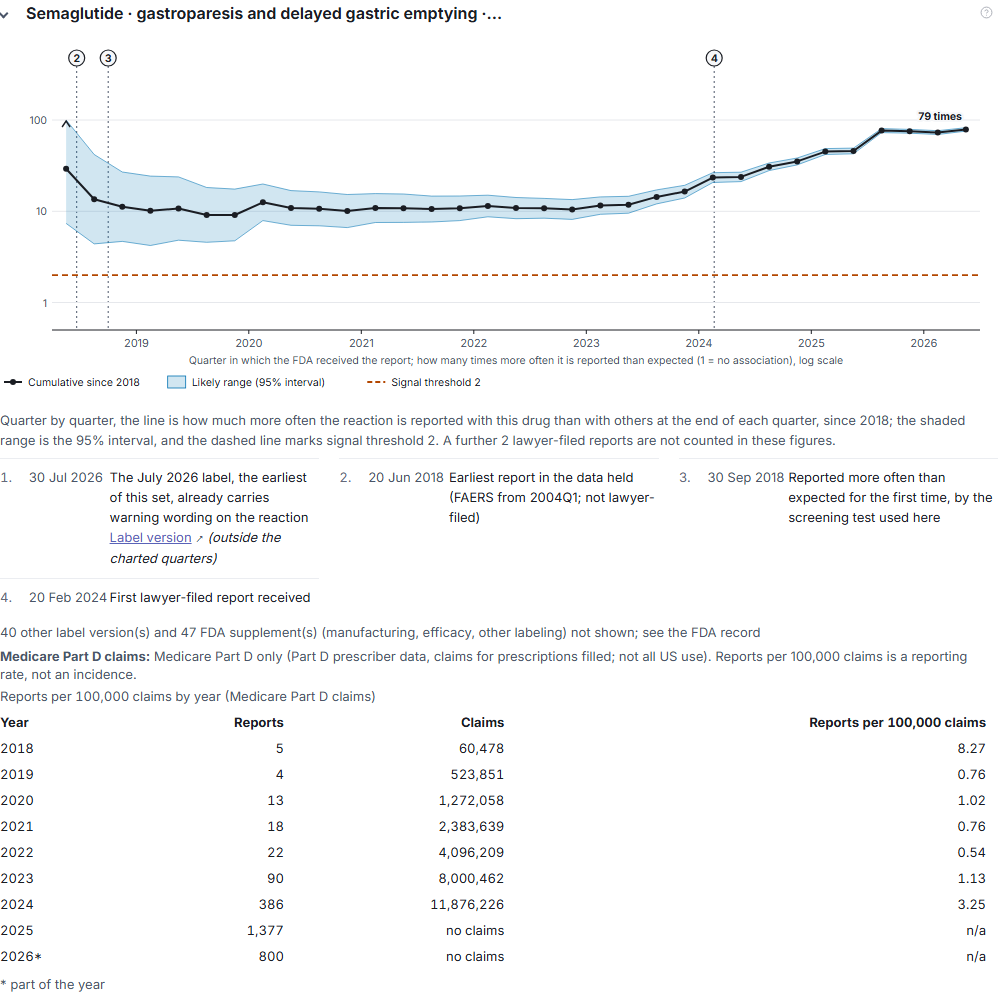
"Is there a disproportionality signal for gastroparesis with semaglutide? Show how it developed over time."
What comes back: the signal by quarter ("The cumulative PRR first met the stated signal rule on Sep 30, 2018, and was 78.9 by 2026Q2"), beside the exposure data: claims per year from Medicare Part D (60,478 in 2018; 11,876,226 in 2024), with reports and claims in separate columns, and, in a separate table, Medicaid prescriptions.
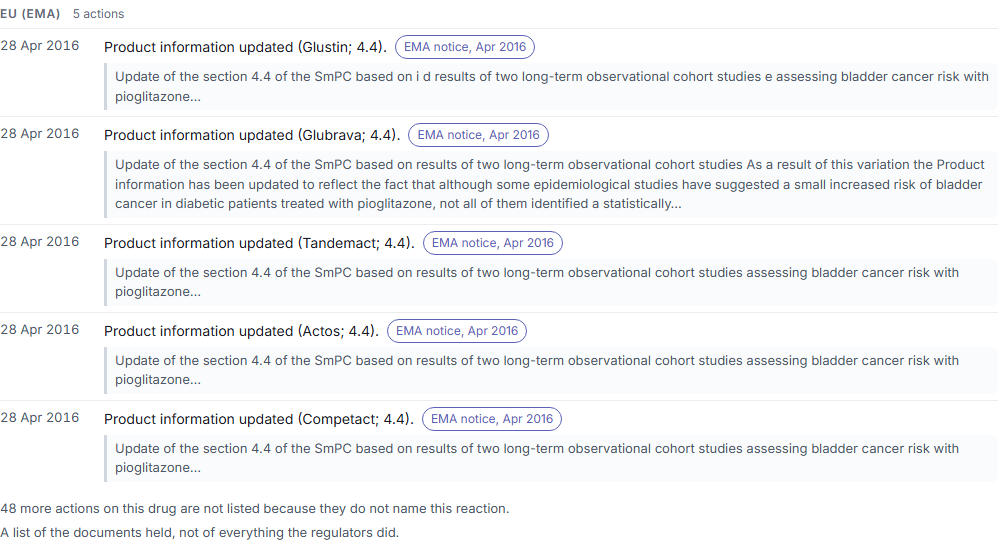
"Did regulators abroad act on pioglitazone and bladder cancer before the US label changed?"
What comes back: each foreign action, dated and quoted: MHRA's communication to prescribers of August 2011 (the MHRA article gives the month only), and EMA's product-information updates of 28 Apr 2016 for Actos, Competact, Glubrava, Glustin and Tandemact. The card marks its scope: "A list of the documents held, not of everything the regulators did."
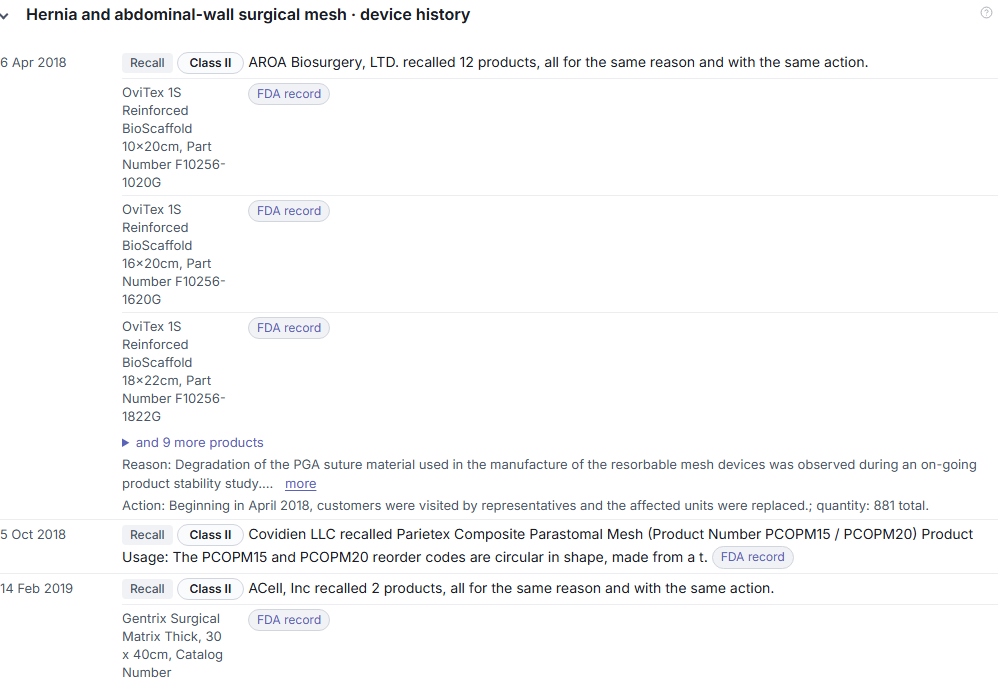
"Surgical mesh migration: what device recalls and adverse event signals exist?"
What comes back: "150 recall product records for surgical polymeric mesh and seven related mesh categories", and a device history card listing up to 60 events by date, firm and class, with the stated reason and the FDA record. The card is a window onto the record, not a total.
Between signing and closing
A watch list keeps the check running. On the Watch lists page, enter a Drug or a Condition, a "Side effect (optional)" and a "Look back" window, then press Start watching. Each check compares the result with the previous one and adds one alert listing the evidence added or removed (a new reporting signal, a new study, a regulator acting abroad, a label change), linked to its source. The first check sets the baseline.
What you can check
- The passage behind each statement, opened beside the answer with the supporting text highlighted.
- The kind of each date: published, submitted or approved.
- "Search scope and limits" under each card: what was searched, so an empty result is read for what it covers.
- The data line under each answer, with the FAERS quarter and the snapshot.
- Copy or download on each card; Export of the answer as PDF or Word.